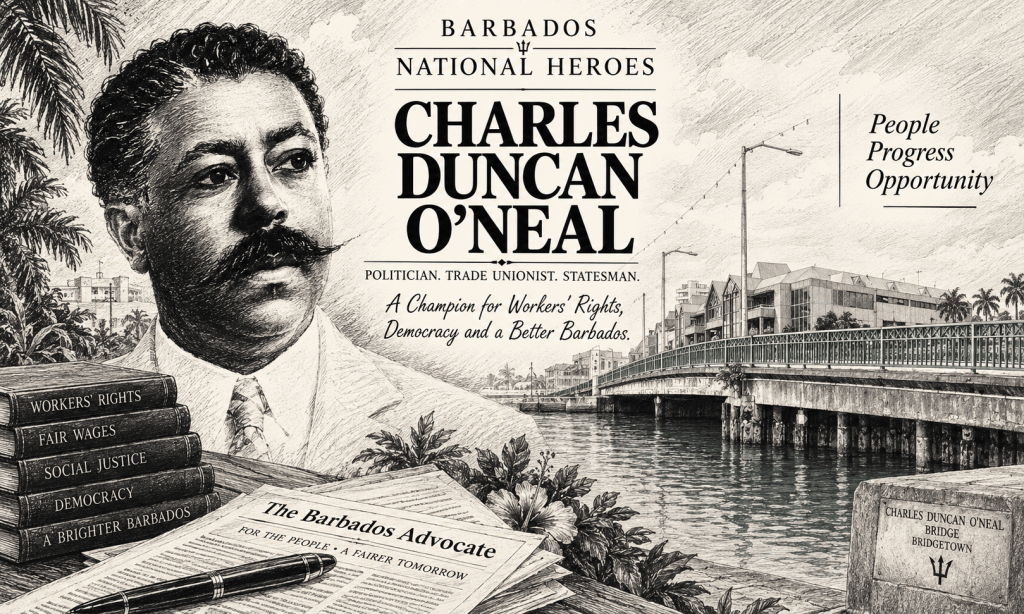
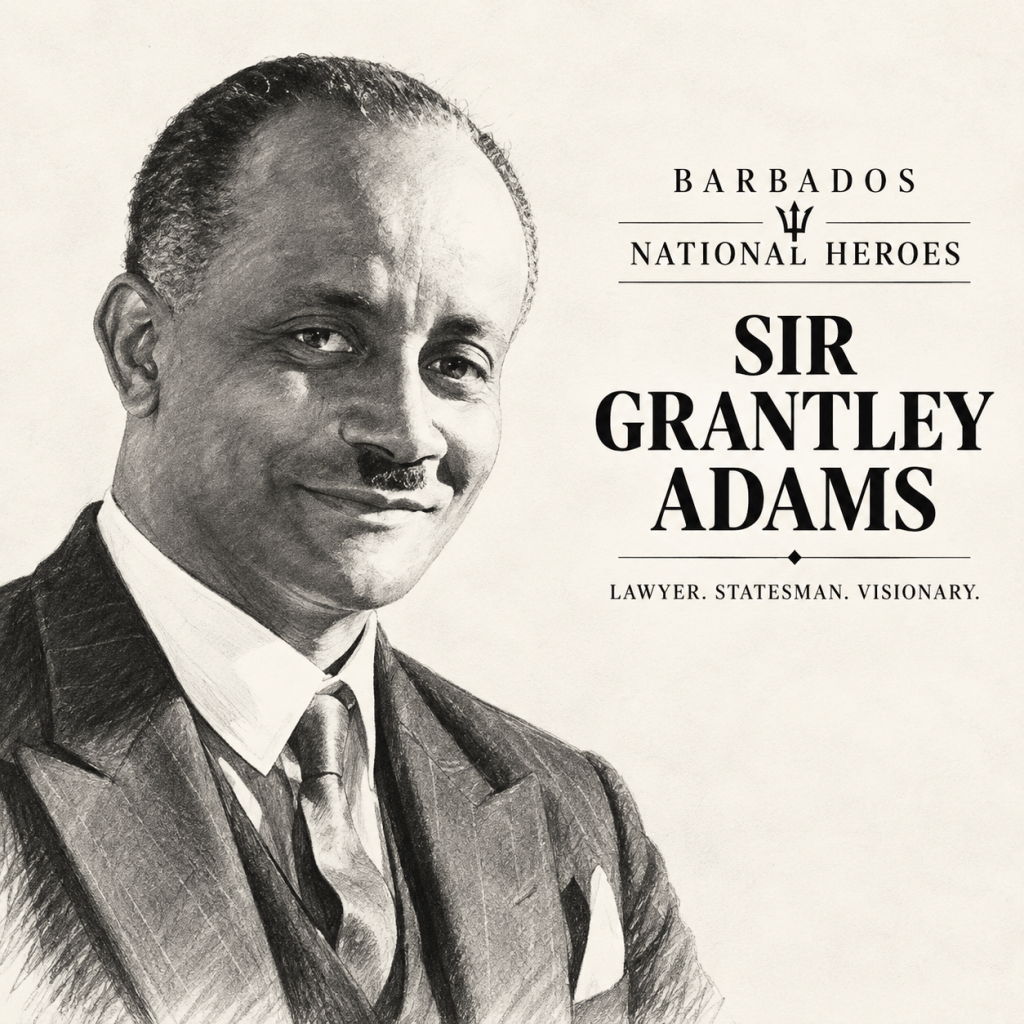
Category: Barbados National Heroes
Week: 4 of 11
Years: 1879–1936
Setting the Scene: Barbados After Slavery, Before Democracy
By the time Charles Duncan O’Neal was born in 1879, slavery in Barbados had been abolished for over four decades — but political power hadn’t shifted nearly as much as freedom had promised. Voting rights were still tightly restricted by property and income requirements: to vote, a Barbadian needed a minimum income and at least an acre of land, or land producing a minimum profit. In practice, this meant the vote stayed almost entirely in the hands of the same wealthy, plantation-owning elite who had run the island under slavery. Most Black and working-class Barbadians — the vast majority of the population — had no formal political voice at all.
Into the early 20th century, this began to shift. As villages grew and a new class of small landholders and tradespeople of colour emerged, a genuinely new voting bloc began to take shape—one with no political home yet, and no party built to represent its interests. That vacuum is where Charles Duncan O’Neal made his mark.
Who Was Charles Duncan O’Neal?
O’Neal was born on November 30, 1879, in Saint Lucy, Barbados, the son of Joseph O’Neal, a blacksmith turned shopkeeper, and Kathleen O’Neal. He was educated at Parry School and then Harrison College, one of Barbados’s most prestigious schools, where he placed second in the 1899 Barbados Scholarship competition—a remarkable achievement for a tradesman’s son in a deeply class-stratified society. That scholarship took him to Edinburgh University in Scotland to study medicine, where he excelled.
After qualifying, O’Neal spent several years building a medical practice in Newcastle, England. It was here, away from Barbados, that his political outlook was shaped. He became involved in local politics himself, winning a seat on the Sunderland County Council, and developed a relationship with Keir Hardie, one of the founding figures of the British Labour Party. Living through the intellectual ferment of the early 20th century — the rise of the international Labour movement, the founding of the British Labour Party, and the broader currents of Marxism and Bolshevism that followed the First World War — O’Neal became a committed democratic socialist. He began to imagine bringing that same working-class political movement back home to the Caribbean.
Returning Home: A Doctor Who Chose the Poor
When O’Neal eventually returned to Barbados, he did something almost unheard of for a man of his background: rather than settling into the comfortable life available to a university-educated professional from the island’s Black upper class, he devoted himself to the poor and the disenfranchised. He was, by most accounts, entirely unconcerned with the damage this might do to his social standing — becoming known as one of the first Barbadian gentlemen of his class to openly reject the expectations that came with it.
O’Neal built a professional relationship with journalist and fellow reformer Clennell Wickham, and together, in October 1924, they founded the Democratic League — a radical political organisation built around O’Neal’s socialist convictions. The League’s early strategy focused on something deceptively simple but genuinely transformative: registering the newly eligible working-class and coloured voters who had emerged as villages expanded, and organizing them into a real political force for the first time.
Just two months after the League’s founding, one of its members, C.A. Braithwaite, was elected to the House of Assembly representing St. Michael — an early proof of concept. Other League members followed him into office over the coming years. O’Neal himself did not win his own seat in the Assembly, representing Bridgetown, until 1932 — eight years after founding the party that had already begun reshaping Barbadian politics without him in office at all.
What the Democratic League Fought For
The Democratic League’s platform reads, in many ways, like a wish list for basic 20th-century social protections that hadn’t yet reached Barbados: compulsory free education, the abolition of child labour, and expanded protections for workers. O’Neal also worked directly on unionising Barbadian workers and personally represented them during strike actions — highly unusual, hands-on work for a man of his professional and social standing.
Beyond labour issues, O’Neal was notably ahead of his time on other fronts too. He’s credited as the first Barbadian politician to campaign specifically for improved workplace conditions for women, and he supported women taking on leadership roles at a time when this was far from a mainstream position. He also founded the Working Men’s Association in 1926, launched a cooperative venture in Bridgetown, and invested in a newspaper, The Herald, to keep promoting his message of social reform through the press — much as Samuel Jackman Prescod had done nearly a century earlier (see week 3 of this series).
Legacy
O’Neal died on November 19, 1936, before seeing many of his goals realized in law. But his influence outlived him in a very direct way: several of the Democratic League’s core aims were later picked up and carried forward by the political parties that came to dominate Barbadian politics after his death — including, eventually, free education, one of the causes he’d championed decades earlier. Perhaps his most lasting structural legacy is less about any single policy and more about how Barbadian politics itself came to function: O’Neal’s party-based, working-class-oriented model helped shift the island’s politics away from a system built around individual personalities and patronage, toward the party-focused political system Barbados still uses today.
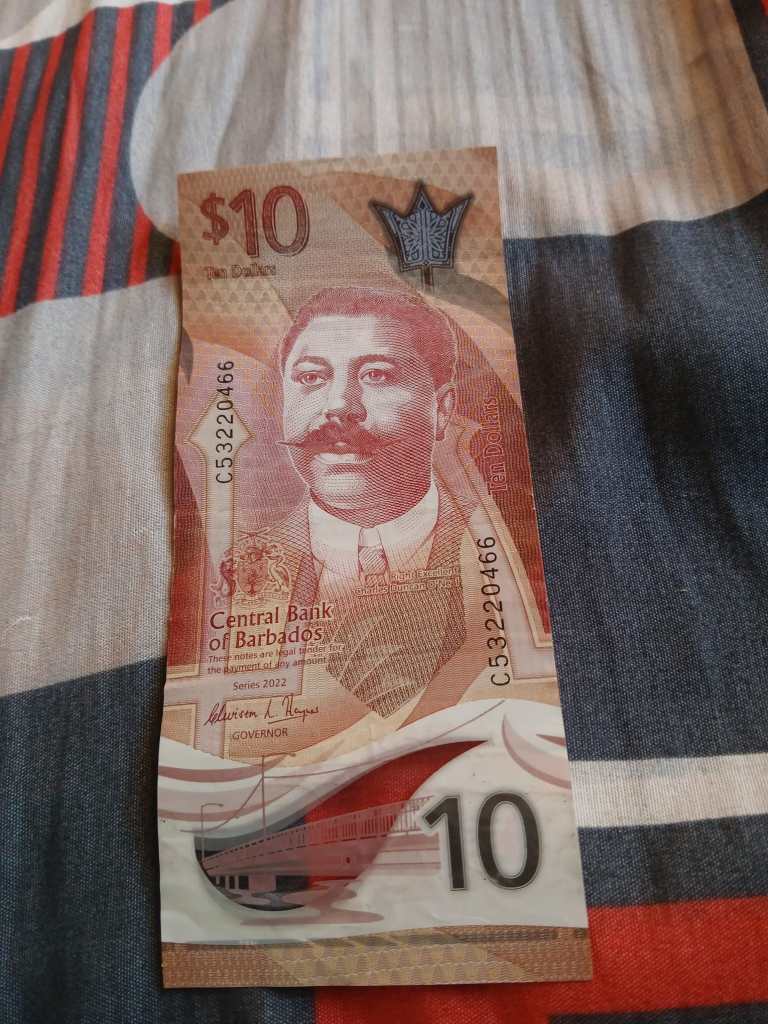
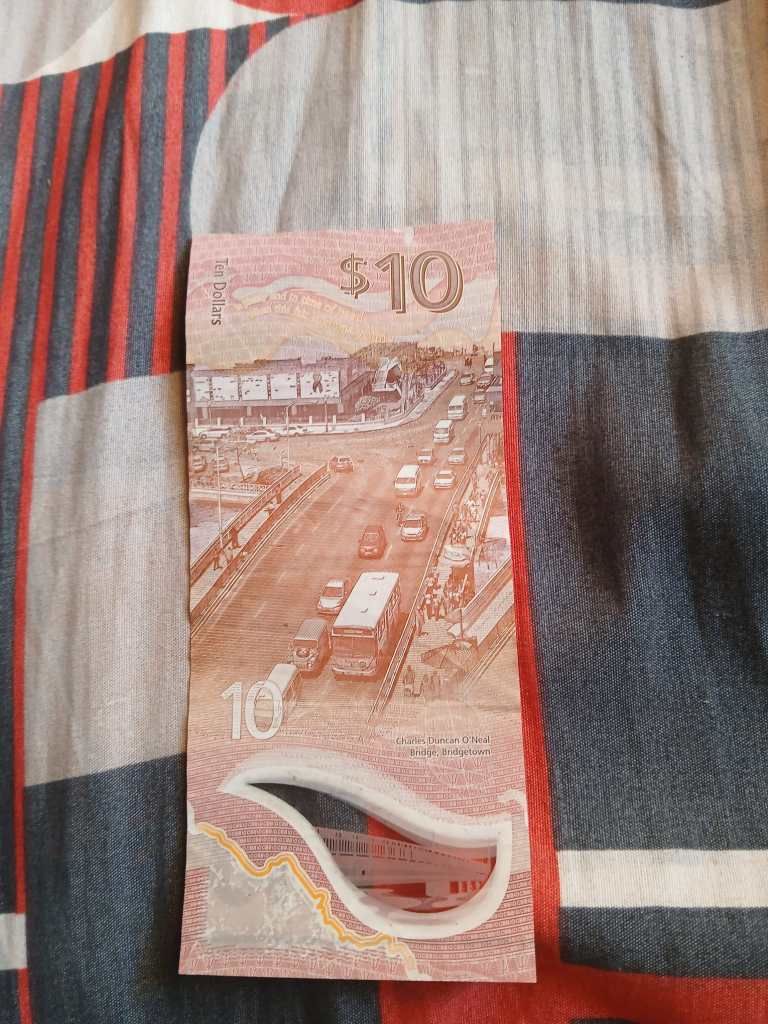
His name lives on across the island. One of the two main bridges over the Careenage in Bridgetown is named the Charles Duncan O’Neal Bridge, and his portrait appears on the Barbadian $10 banknote.
Why Charles Duncan O’Neal Is a National Hero
When Barbados’s Order of National Heroes was established in 1998, O’Neal was honoured as the man who gave Barbados’s working class its first real organised political voice. Where Samuel Jackman Prescod (week 3) broke into a system built to exclude him, O’Neal — already an insider by education and profession — chose to build an entirely new political vehicle for the people that system continued to exclude, at real cost to his own social standing. It’s a different kind of courage: not the courage of someone fighting their way in, but of someone with a seat already reserved for them choosing instead to build a door for everyone else.
Family Reflection
A few questions to talk through together this week:
- O’Neal came from a privileged, educated background but chose to dedicate his life to the poor and working class. Why do you think that choice was so unusual — and risky — for someone in his position?
- The Democratic League didn’t win power outright, but many of its ideas were eventually adopted by other parties after O’Neal’s death. Do you think that still counts as success? Why or why not?
- O’Neal campaigned for causes like free education and the end of child labour, which many countries now take for granted. What does it tell you about a society that these had to be fought for?
Sources
- Charles Duncan O’Neal — Wikipedia
- Totally Barbados: Charles Duncan O’Neal — National Hero of Barbados
- Caribbean National Weekly: Charles Duncan O’Neal the People’s Doctor
- Barbados Government Information Service: Historian Takes a Look at the Life of National Hero, Dr. Charles Duncan O’Neal
- New World Journal: Duncan O’Neale — Apostle of Freedom
Part of the “Barbados National Heroes” series on Child of the Caribbean.



Leave a Reply