Growing up in the Caribbean, many of us learnt our countries by the names we know today: Barbados, Jamaica, Saint Lucia, Grenada, Dominica, Trinidad and Tobago. We learnt the flags, capitals, national dishes and perhaps a little about independence. But how often were we taught what these places were called before Europeans renamed them?
That question sent me down a fascinating path.
Long before Columbus and other Europeans arrived, the Caribbean was already home to Indigenous peoples with their own communities, languages, trade networks and names for the places around them. Among them were the Taíno, Lucayan Taíno, Kalinago, Lokono and other Indigenous peoples, while the mainland Caribbean was home to numerous Maya and Indigenous South American nations.
Some of their names survived. Others were changed, adapted or replaced. In a few remarkable cases, an Indigenous name eventually became the modern country’s name.
Let’s travel around the Caribbean and discover some of them.
A Note Before We Begin
Writing about Indigenous Caribbean names is not as straightforward as I first expected.
The modern Caribbean countries we know today did not exist in their present political form before European colonisation. Antigua and Barbuda, for example, was not one Indigenous country called Antigua and Barbuda. The individual islands had their own histories and names.
There is another difficulty. Indigenous Caribbean languages were largely oral, so many of the spellings that survive were written down by Europeans attempting to record unfamiliar words. That means the same name can appear with several spellings.
And although older historical sources often use the word “Carib”, I generally use Kalinago when referring to the Indigenous people themselves, except when explaining terminology used in a historical source.
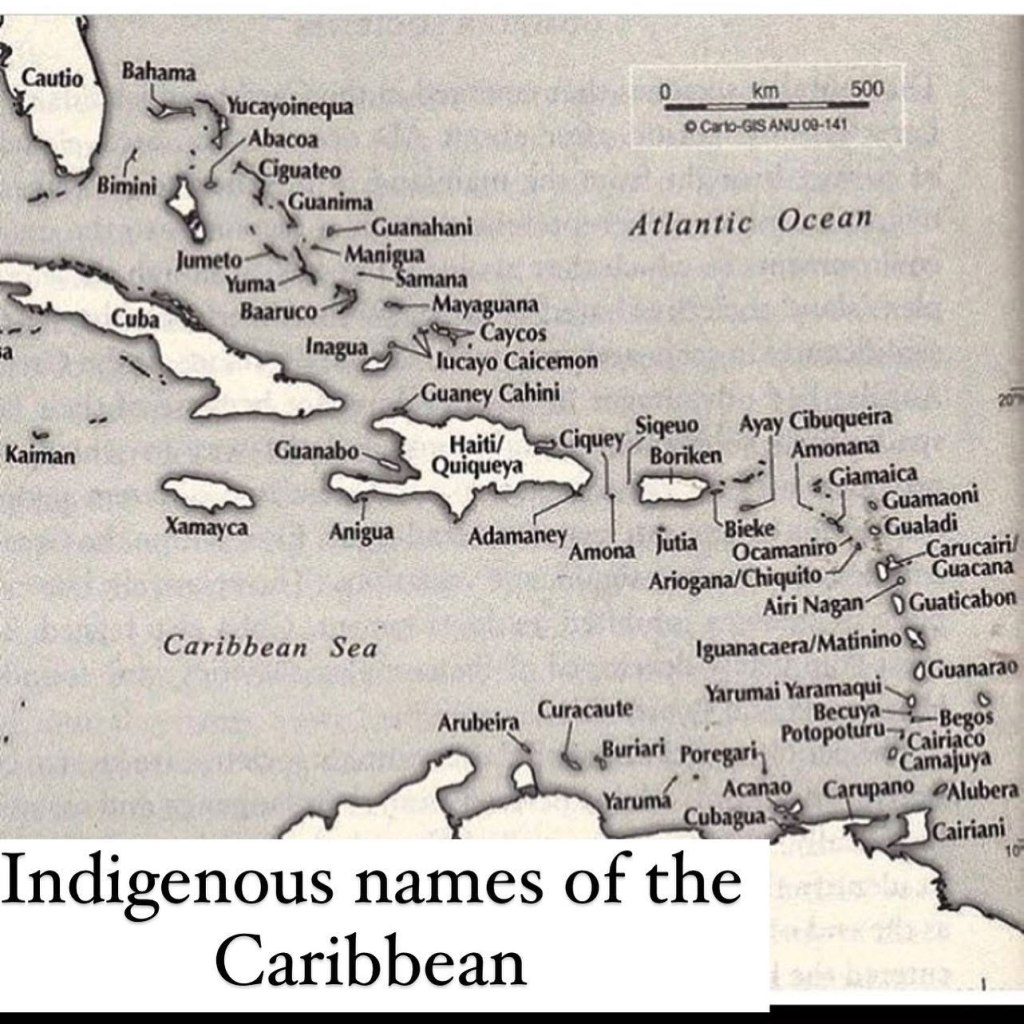
Indigenous Names of the Caribbean
| Modern Caribbean Country | Indigenous Name | Indigenous people associated with the name | What we know |
|---|---|---|---|
| Antigua and Barbuda | Waladli/Wadadli (Antigua); Wa’Omoni (Barbuda) | Indigenous peoples of the Lesser Antilles, commonly associated with Arawakan-speaking communities and later Kalinago presence | Waladli is widely associated with Antigua, with Wadadli remaining a familiar form of the name today. Wa’Omoni is recorded for Barbuda. |
| The Bahamas | No single securely documented Indigenous name for the modern Bahamas | Lucayan Taíno | The Lucayans inhabited the Bahamian archipelago. Individual islands had Indigenous names, but there is no good evidence that the hundreds of islands making up today’s Bahamas shared one Indigenous national name. |
| Barbados | Ichirouganaim | Usually associated with Indigenous Arawakan-speaking inhabitants of the Lesser Antilles | You may see it translated online as something resembling “red land with white teeth”. |
| Belize | No securely established name for the entire modern territory | Maya peoples | This one surprised me. Belize Tourism Board’s own historical material states that historians do not know what the Maya called the territory that is now Belize. Rather than inventing an ancient national name, it is more accurate simply to acknowledge that uncertainty. |
| Cuba | Cuba, with historical variants proposed | Taíno and other Indigenous communities of Cuba | Unlike many Caribbean countries, Cuba’s modern name is generally regarded as Indigenous in origin. Different explanations have been proposed for its original meaning, but there is no single translation I am comfortable presenting as certain. |
| Dominica | Wai’tukubuli / Waitukubuli | Kalinago | Wai’tukubuli is the Kalinago name for Dominica and is commonly translated as “Tall is her body”, beautifully reflecting the island’s long, mountainous landscape. |
| Dominican Republic | Ayiti and other names associated with Hispaniola | Taíno | The Dominican Republic occupies the eastern part of the island shared with Haiti. The Taíno name Ayiti is associated with the island and its mountainous landscape. It should not, however, be presented as though it referred exclusively to the territory of the modern Dominican Republic. |
| Grenada | Camerhogne / Camerhougue | Kalinago, traditionally called Caribs in older records | The Government of Grenada records Camerhougue as an earlier name of the island and identifies Carib Indians as its traditional inhabitants. |
| Guyana | Guiana/Guyana | Indigenous peoples of the Guianas; Guyanese sources particularly associate early settlement with Arawak and Carib peoples | Here the Indigenous heritage survives in the country’s modern name. Official Guyanese sources describe Guyana as an Amerindian word meaning “Land of Many Waters” — very fitting for a country filled with rivers and waterways. |
| Haiti | Ayiti | Taíno | Ayiti is a Taíno name commonly associated with mountainous land. When Haiti declared independence in 1804, the Indigenous name was restored rather than retaining the French colonial name Saint-Domingue. |
| Jamaica | Xaymaca / Xamayca | Taíno | Jamaica’s modern name developed from its Taíno name. The National Library of Jamaica records Xaymaca, possibly meaning “land of springs”, and also discusses the familiar interpretation “land of wood and water.” |
| Saint Kitts and Nevis | Liamuiga (Saint Kitts); Oualie (Nevis) | Indigenous peoples of the Lesser Antilles, commonly associated with Kalinago history | Liamuiga is traditionally interpreted as “fertile land”, while Oualie is often rendered “land of beautiful waters.” These translations are widely repeated, but I would describe them as traditional interpretations rather than indisputable linguistic translations. |
| Saint Lucia | Iouanalao; later Hewanorra | Arawakan-speaking Indigenous inhabitants and Kalinago | Saint Lucia’s own government gives us an unusually interesting account. The Amerindians encountered by Europeans called the island Iouanalao. A seventeenth-century source associated it with iguanas. The government also records Hewanorra, used by Caribs/Kalinago in a 1663 transaction, while noting historical uncertainty over the linguistic origin of the name. |
| Saint Vincent and the Grenadines | Hairouna (Saint Vincent) | Kalinago | Hairouna is traditionally associated with Saint Vincent and is commonly translated as “Land of the Blessed.” The Grenadines themselves consist of multiple islands, so we should not treat Hairouna as though it were an ancient name for the entire modern state. |
| Suriname | Suriname is itself Indigenous-derived | Traditionally associated with the Surinen, an Indigenous people | Rather wonderfully, another Caribbean country’s present name preserves Indigenous history. Suriname is generally understood to derive from the name of an Indigenous people who inhabited the region, although the precise linguistic development of the modern name is debated. |
| Trinidad and Tobago | Kairi / Cairi / Caeri (Trinidad) | Several First Peoples, including Lokono/Arawak, Karina/Kalinago, Nepuyo, Warao and other communities | Trinidad’s National Library records Kairi/Cairi/Caeri, meaning “the island”, as a name used by the ancestors of today’s Santa Rosa First Peoples Community. The famous phrase “Land of the Hummingbird” is often associated with Trinidad, but the history of that translation is more complicated than popular retellings sometimes suggest. |
Why I Want Caribbean Children to Know These Names
The more I researched this subject, the more I realised that this isn’t really a story about old names.
It is about who gets remembered.
If we begin Caribbean history with Columbus, slavery or European colonisation, our children can easily receive the impression that the Caribbean was somehow waiting to be discovered. It wasn’t.
People were already here.
They had families and communities. They travelled between islands. They fished, farmed and traded. They understood the sea and the landscape around them. They had spiritual traditions, languages and names for the places where they lived.
And their descendants have not simply vanished from Caribbean history. Indigenous communities continue to exist in our region today. Guyana’s Ministry of Amerindian Affairs, for example, recognises nine Indigenous nations, while Trinidad’s Santa Rosa First Peoples Community preserves a living Indigenous heritage. Ministry of Amerindian Affairs
That is why I don’t want Child of the Caribbean simply to teach children that “Columbus renamed this island”.
I want them to know what came before.
Try This With Your Children
The next time you look at a map of the Caribbean with your children, choose your family’s island and find its modern name. Then find its Indigenous name, where one is reliably known.
Say both names aloud.
Jamaica — Xaymaca.
Dominica — Wai’tukubuli.
Saint Vincent — Hairouna.
Trinidad — Kairi.
Then ask a simple question:
Who lived here before Europeans arrived?
That one question can lead to conversations about the Taíno, Kalinago, Lucayans, Lokono, Maya and the many other Indigenous peoples whose histories form part of the Caribbean story.
And perhaps that is the most important lesson of all. Our history did not begin when someone else arrived and wrote about us.
The Caribbean already had a story.
Did you know the Indigenous name connected with your island or country? Is there another name or spelling that your grandparents or community taught you? Share it in the comments — I would love to hear what you grew up knowing.
Sources and Further Reading
National Library of Jamaica – History Notes: Jamaica. Information about the Taíno people and the name Xaymaca. National Library of Jamaica
National Library of Jamaica – History Notes
Government of Saint Lucia – Brief History of Saint Lucia. Discusses Iouanalao, Hewanorra and the uncertainty surrounding their origins. Saint Lucia – Access Government
Government of Saint Lucia – History
Government of Grenada – About Grenada. Records Camerhougue as an earlier name of Grenada and discusses its Indigenous inhabitants. Government of Grenada | Web Portal
Government of Grenada – About Grenada
National Library and Information System Authority of Trinidad and Tobago – Santa Rosa First Peoples Community Heritage Week. Discusses Kairi/Cairi/Caeri and Trinidad’s First Peoples. Nalis
NALIS Trinidad and Tobago – First Peoples Heritage
Guyana Lands and Surveys Commission – Fact Page on Guyana. Explains the Indigenous origin and meaning of the country’s name. FactPage
Guyana Lands and Surveys Commission
Ministry of Amerindian Affairs, Guyana – Indigenous Nations. Information about Guyana’s nine recognised Indigenous nations. Ministry of Amerindian Affairs
Guyana Ministry of Amerindian Affairs – Indigenous Nations
Belize Tourism Board – National Tour Guide Training Program. Discusses Maya history and explains that historians do not know the Maya name for the entire territory now called Belize. Belize Tourism Board
Belize Tourism Board – National Tour Guide Training Programme
List of Indigenous Names of the Caribbean- Wikipedia
Historical spellings and translations of Indigenous Caribbean names vary between sources.



Leave a Reply