There are some Caribbean recipes that come with measurements, carefully written instructions and exact cooking times.
And then there are the recipes you get from your family.
I recently asked my sister how she makes Bajan cherry drink. I expected something along the lines of two cups of cherries, four cups of water and a certain amount of sugar.
Her instructions were much simpler:
Blend the cherries and strain them. Add water and sugar to taste.
Fair enough.
So naturally, I asked the question anyone trying to write down an actual recipe would ask:
“But what are the measurements?”
Her answer?
“Shake till the ancestors say to stop.”
And there it was: perhaps the most Caribbean recipe measurement I could have received.
No measuring cup. No kitchen scales. No carefully levelled tablespoon.
Just you, the container, the ingredients — and apparently several generations of family members supervising from beyond.
But behind the joke is something I genuinely love about Caribbean food culture. So much of what we know about food was never learnt from a cookbook. It was learnt by watching, tasting, smelling and eventually developing that instinct that tells you when something is right.
And Bajan cherry is one of those fruits that deserves to have its story told.
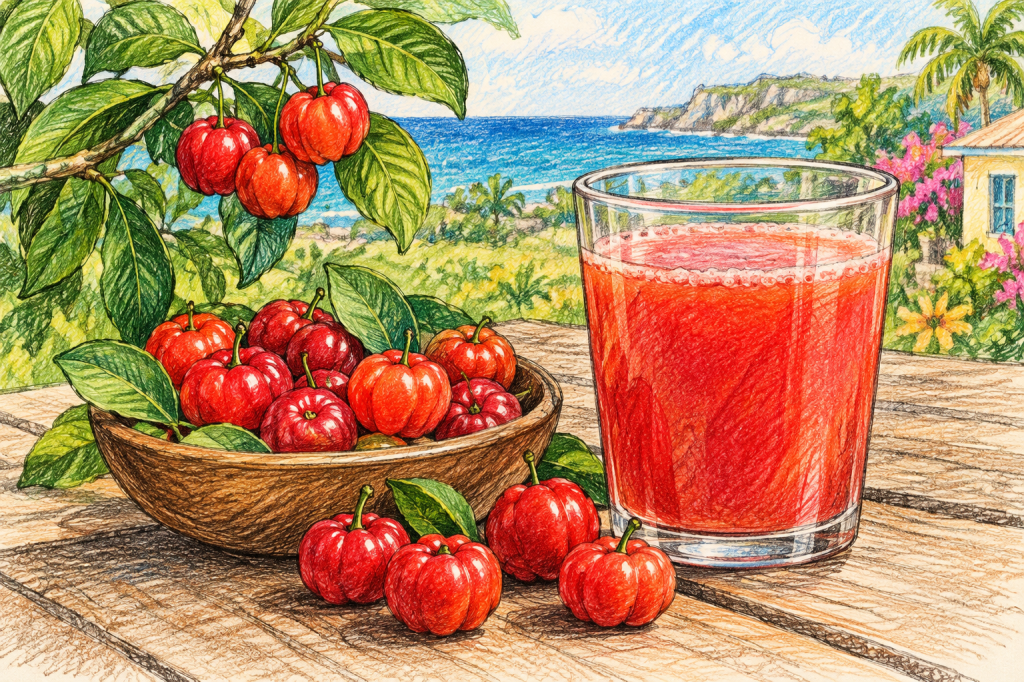
What Is Bajan Cherry?
If you are from Barbados, you may simply know it as Bajan cherry or Barbados cherry. Elsewhere, you are likely to hear names such as acerola or West Indian cherry.
Its scientific name is Malpighia emarginata, and despite being called a cherry, it is not the same fruit as the familiar sweet and sour cherries belonging to the genus Prunus.
The fruit is small, usually bright red when ripe, with a thin skin and juicy flesh surrounding several seeds. Its flavour can range from pleasantly tart to quite sharp, with sweetness increasing as the fruit ripens.
For those of us who grew up around Caribbean fruit trees, however, the botanical description only tells part of the story.
You knew the tree.
You knew when the cherries were ready.
And you certainly knew that if you wanted enough to make a drink, you needed considerably more than the handful you had already eaten while picking them.
Is Bajan Cherry Actually From Barbados?
The name Barbados cherry can make it sound as though the fruit originated specifically in Barbados, but its history is broader than that.
Acerola is native to parts of the tropical Americas and Caribbean region and has become strongly associated with the West Indies. It grows well in warm tropical and subtropical climates and is now cultivated in several parts of the world.
In Barbados, however, it became familiar enough to earn one of its most recognisable names.
And that is something I find interesting about Caribbean food. A plant doesn’t necessarily have to originate on one particular island to become woven into that island’s food culture. What matters is what generations of people eventually do with it.
We pick it.
We share it.
We turn it into drinks, preserves and other foods.
And eventually it becomes part of home.
That Beautiful Bajan Cherry Tree
A Bajan cherry tree is not one of those enormous Caribbean fruit trees towering over the entire yard. It is generally a smaller tree or shrub, which can make the fruit relatively easy to pick.
When it is producing well, those little red cherries stand out beautifully against the green leaves.
The difficult part is getting the timing right. Pick the fruit too early and it can be very tart. Leave a beautifully ripe cherry sitting there for too long and you may discover that somebody — human or otherwise — got there before you.
Anyone who grew up with fruit trees in the yard understands that there is an unofficial Caribbean law governing them:
The fruit belongs to whoever sees it ripe first.
At least, that seemed to be the rule when we were children.
Bajan Cherry Is Famous for Its Vitamin C
There is another reason acerola has attracted attention far beyond the Caribbean: it is exceptionally rich in vitamin C.
Vitamin C has several important functions in the body. It contributes to normal immune function, helps with collagen formation and acts as an antioxidant. Acerola also contains naturally occurring plant compounds, including carotenoids and polyphenols.
That impressive nutritional profile has led to acerola being used commercially in juices, powders, extracts and supplements.
But I think there is something rather amusing about seeing an expensive packet of “acerola superfruit powder” when you grew up knowing the same thing as the little red cherries somebody had growing outside.
Sometimes the rest of the world discovers a “superfood” and Caribbean people are left thinking:
You mean that thing from the yard?
How We Make Bajan Cherry Drink
Now we arrive at my sister’s wonderfully precise recipe.
Traditional family recipes are difficult to standardise because the fruit itself changes. One batch of cherries may be sweeter than another, and different families prefer different levels of sweetness and strength.
So, in honour of my sister, I am giving you both versions.
My Sister’s Traditional Caribbean Method
Ingredients
- Ripe Bajan cherries
- Water
- Sugar
Method
Wash the cherries thoroughly and remove any damaged fruit. Put the cherries into a blender with enough water to help them blend easily, then blend until the fruit has broken down.
Strain the mixture through a fine sieve to remove the seeds and unwanted pulp.
Add more water until the drink reaches the strength you like, then sweeten with sugar according to your taste.
Chill well before serving.
And how much of everything should you use?
According to my sister:
“Shake till the ancestors say to stop.”
I cannot improve upon those instructions.
For Those of Us Whose Ancestors Aren’t Giving Measurements
If you’re trying Bajan cherry drink for the first time and would prefer a starting point, you could try approximately:
| Ingredient | Starting amount |
|---|---|
| Ripe Bajan cherries | 2 cups |
| Water for blending | 2 cups |
| Additional water | 1–2 cups, as needed |
| Sugar | Start with 2–3 tablespoons and adjust |
These aren’t meant to be strict measurements. Think of them as somewhere to begin.
Blend the cherries with some of the water and strain the mixture. Taste it before adding anything else. Then gradually add water until you are happy with the strength, followed by a little sugar at a time.
If your cherries are particularly tart, you may want more sugar. If they’re beautifully ripe and naturally sweet, you may need much less.
The important Caribbean measurement is still:
Taste it.
If it tastes right, you’re finished.
Why Our Family Recipes Are So Hard to Write Down
My sister’s answer made me laugh, but it also made me think about how Caribbean recipes have traditionally travelled through families.
Ask an older relative how much seasoning goes into something and you may hear:
“A little bit.”
How much water?
“Enough.”
How long should it cook?
“Till it done.”
How will I know when it’s done?
A look usually follows that question.
And somehow, despite these spectacularly vague instructions, generations before us managed to reproduce the dishes.
That’s because cooking was often taught through participation rather than written recipes. You stood beside somebody. You watched how much they poured. You noticed the consistency. You tasted what they made. Eventually your hands learnt what the recipe book never explained.
That knowledge matters.
At the same time, there is value in writing some of it down. Families move. Children grow up overseas. Grandparents and parents who carried particular recipes are eventually no longer there to answer our questions.
One day, somebody may genuinely want to know how Grandma made that cherry drink.
And “shake till the ancestors say to stop” may be culturally accurate, but it isn’t going to help everybody.
Although I must admit, it makes for a much better family story.
More Than Just Cherry Drink
Fresh Bajan cherries can be eaten straight from the tree when ripe, although their tartness isn’t for everyone. The fruit can also be used for juices, syrups, jams, jellies and other preserves.
Freezing the fruit or pulp can be useful when a tree produces more cherries than you can use immediately.
And that abundance is another familiar part of Caribbean yard culture. When a fruit tree really starts producing, suddenly there is far more fruit than one household can reasonably eat.
That’s when bags start travelling.
Some go to neighbours. Some go to relatives. Someone announces that they’re making juice. Somebody else decides to make jam.
There was community in that simple exchange of food, even when nobody gave it a special name.
Preserving the Recipe and the Story
This is exactly the kind of memory I want to preserve through Child of the Caribbean.
Yes, I want our children to know that acerola is Malpighia emarginata. I want them to understand that it is rich in vitamin C and that the fruit has a history extending across the tropical Americas and Caribbean.
But I also want them to know the other history.
The history that isn’t always found in books.
The auntie who didn’t measure anything.
The grandmother who knew when something was ready simply by looking at it.
The fruit tree everybody remembered from someone’s yard.
The bag of fruit sent home after a visit.
And the sister who, when asked for an actual measurement, confidently replied:
“Shake till the ancestors say to stop.”
Because Caribbean heritage isn’t only contained in museums, archives and history books.
Sometimes it is sitting in a blender.
And sometimes the person holding the recipe refuses to give you a measurement.
Do you remember drinking Bajan cherry juice growing up? And what wonderfully unhelpful Caribbean cooking instructions have your parents or grandparents given you? Tell me in the comments — I have a feeling “shake till the ancestors say stop” has plenty of competition.
With love,
Vivian Ladean
Child of the Caribbean
Sources and Further Reading
Royal Botanic Gardens, Kew – Plants of the World Online: Malpighia emarginata. Botanical information and accepted scientific classification for the acerola or Barbados cherry.
Nutritionvalue. Nutritional information for acerola/West Indian cherry, including its vitamin C content.
National Institutes of Health, Office of Dietary Supplements – Vitamin C Fact Sheet. Information about the functions of vitamin C, including its role in collagen synthesis, antioxidant activity and normal immune function.
Disclaimer: This article is for general educational and cultural information. References to the nutritional properties of Bajan cherry are not intended as medical advice or as claims that the fruit can prevent, treat or cure disease.






Leave a Reply