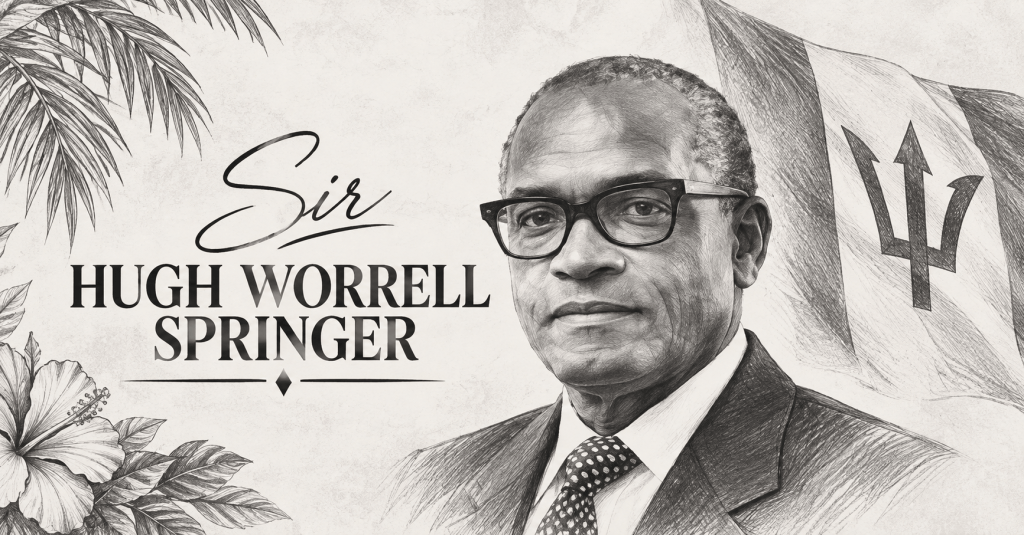
Category: Barbados National Heroes
Week: 7 of 11
Years: 1913–1994
Setting the Scene: Barbados After the Riots
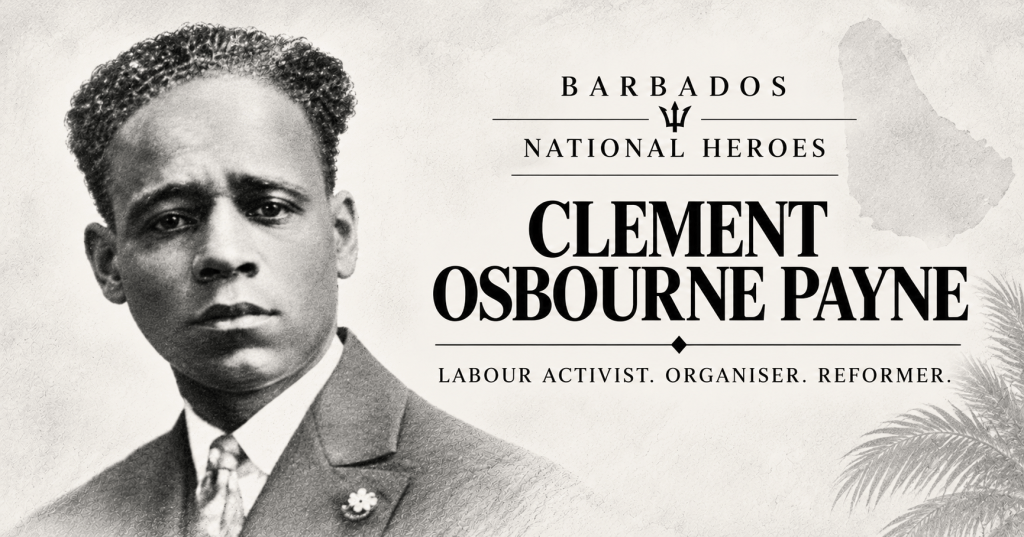
By 1938, Barbados was still reeling from the 1937 riots sparked by Clement Payne’s deportation (week 6 of this series). The Moyne Commission’s findings had confirmed that Payne’s grievances were legitimate, and the island’s fledgling labour movement — led by figures like Grantley Adams (week 5) — was scrambling to build the formal institutions needed to translate that unrest into lasting change. What Barbados needed next wasn’t another spark. It needed builders: people who could take the anger and energy of 1937 and turn it into unions, parties, and durable political structures.
Hugh Springer, a young lawyer freshly returned from England, turned out to be exactly that kind of builder — and he would go on to spend the next five decades doing it across an extraordinary range of institutions, culminating in the highest office Barbados could offer one of its own citizens.
Who Was Hugh Springer?
Hugh Worrell Springer was born on June 22, 1913, in the parish of St. Michael, Barbados. Like several other heroes already covered in this series, his path to prominence ran through Harrison College and the Barbados Scholarship — he won the Scholarship in Classics in 1931 and used it to study Greek as an undergraduate at Hertford College, Oxford, earning his BA in 1936. He went on to study law at the Inner Temple in London and was called to the bar in 1938.
After finishing his studies, Springer briefly sought a teaching post at one of London’s most respected teacher training colleges. He was told plainly that his ethnicity made him unsuitable for the role — a direct, unambiguous experience of the racism embedded in British institutions of the time. Rather than let that rejection define his path, Springer returned to Barbados, arriving shortly after the 1937 riots, ready to put his legal training to work at home instead.
Building the Movement: Unions and the BLP
Back in Barbados, Springer aligned himself with Grantley Adams, and together they helped form the Barbados Progressive League — the organisation that would later evolve into the Barbados Labour Party. Springer won a seat in the 1940 General Election representing St. George under the Progressive League banner, but his most significant early contribution wasn’t as an elected politician — it was as an institution-builder.
Springer became the organiser and first General Secretary of the Barbados Progressive League between 1940 and 1947, and — critically — he was the organiser and first General Secretary of the Barbados Workers’ Union, the labour organisation that Grantley Adams would later lead as President from 1941 to 1954. In other words: the very union movement that grew directly out of Clement Payne’s 1937 agitation was, in its formal, organised shape, built by Hugh Springer. He also served as General Secretary of the Barbados Labour Party itself, giving him a hand in shaping both the political and industrial wings of the same broader movement.
A Career Across the Commonwealth
Unlike most of the other National Heroes in this series, Springer’s career didn’t stay confined to Barbados. Over the following decades, he moved through an extraordinary range of high-level roles across the wider Commonwealth, almost always centred on education and public administration:
- He served as Acting Governor and Commander-in-Chief of Barbados at various points before independence.
- He became the Director of the Commonwealth Education Liaison Unit.
- From 1966 to 1970, he served as Assistant Secretary-General (Education) at the Commonwealth Secretariat, where he played a pivotal role in developing the Commonwealth Scholarship and Fellowship Program — a program that has since sent thousands of students across the Commonwealth to study abroad, not unlike the very Barbados Scholarship that had opened doors for Springer himself.
- He later served as Secretary-General of the Association of Commonwealth Universities, capping a career almost entirely devoted to expanding access to education across the former British Empire.
He retired from active university administration in 1963 and became a Senior Visiting Fellow at All Souls’ College, Oxford — the same university system that had once told him his ethnicity disqualified him from teaching there.
Governor-General of Barbados
Springer’s crowning public role came late in life. When Sir Deighton Lisle Ward, Barbados’s third Governor-General, died in office in 1984, Springer was knighted and appointed as the island’s fourth Governor-General — its Head of State, representing the Barbadian monarchy following independence. He served in that role for six years, working under three different Prime Ministers: Harold Bernard St. John, Errol Barrow (week 9 of this series), and Lloyd Erskine Sandiford.
Springer was forced to retire from the post in 1990 due to failing health. He died on April 14, 1994, in Bridgetown, at the age of 80.
Why Hugh Springer Is a National Hero
When Barbados named its National Heroes in 1998, Springer was honoured as, in the words of one tribute, one of the greatest Barbadians of all time — not for a single dramatic act of resistance, but for a lifetime spent quietly building the institutions that made Barbadian self-governance actually function. Where Clement Payne provided the spark and Grantley Adams provided the political leadership, Springer provided the scaffolding: the union, the party machinery, and eventually decades of steady, high-level public service that culminated in him becoming the nation’s own Head of State.
His story also reminds us that not every path to becoming a National Hero runs through a single defining confrontation. Some, like Springer’s, run through decades of patient, unglamorous institution-building — the kind of work that rarely makes headlines in the moment, but that everything else in this series ultimately depends on.
Family Reflection
A few questions to talk through together this week:
- Springer was told in London that his ethnicity disqualified him from teaching there, yet decades later he became a Senior Visiting Fellow at Oxford itself. What do you think it took to keep going after a rejection like that?
- Unlike some heroes in this series, Springer isn’t remembered for one dramatic moment, but for decades of steady institution-building. Why do you think that kind of contribution can be just as important, even if it’s less dramatic?
- Springer helped build both a labour union and a political party. Why do you think a country’s workers and its politics often need to be organised together, not separately?
Sources
- Hugh Springer — Wikipedia
- Totally Barbados: Sir Hugh Worrell Springer — National Hero
- Totally Barbados: Sir Hugh Worrell Springer (Governor-General profile)
- The University of the West Indies, Office of the Vice Chancellor: Sir Hugh Worrell Springer
- Caribbean National Weekly: Sir Hugh Worrell Springer, a Lifetime of Public Service
Part of the “Barbados National Heroes” series on Child of the Caribbean.



Leave a Reply