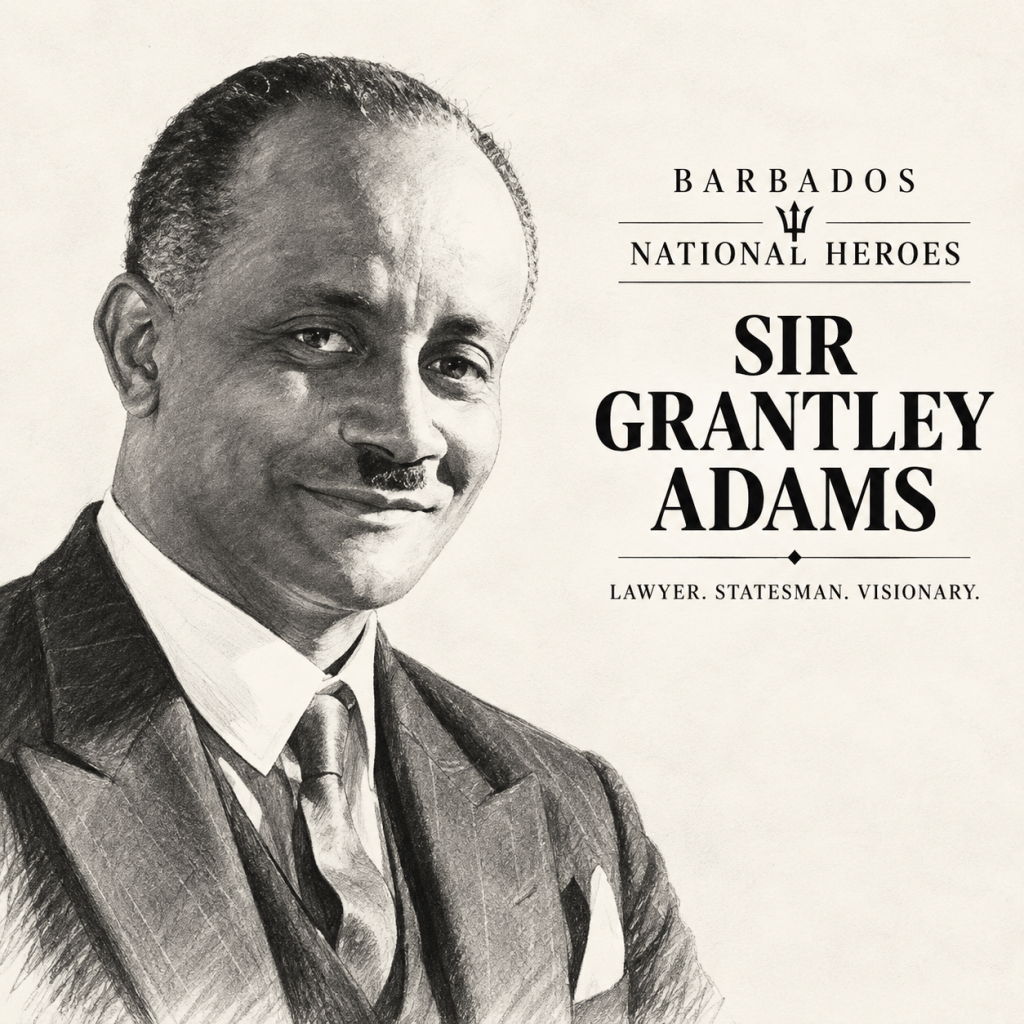
Category: Barbados National Heroes
Week: 5 of 11
Years: 1898–1971
Setting the Scene: A Colony Still Ruled by the Few
By the early 20th century, Barbados had made only halting progress on political inclusion since the days of Samuel Jackman Prescod (week 3) and Charles Duncan O’Neal (week 4). Property and income requirements still kept the vote firmly in the hands of the wealthy, and real legislative power remained concentrated among a small, mostly white “plantocracy” — a term Barbadians used for the planter class that had effectively run the island’s affairs since slavery. Movements like O’Neal’s Democratic League had begun cracking that system open in the 1920s and ’30s, but full democracy — the idea that every adult, regardless of income or land ownership, should have a vote — still didn’t exist.
It would take another Barbadian, a lawyer and master of debate named Grantley Adams, to finish the job O’Neal had started, and to carry Barbados the rest of the way from colonial subject to self-governing nation.
Who Was Grantley Adams?
Grantley Herbert Adams was born on April 28, 1898, at Colliston, Government Hill, in the parish of St. Michael — the third of seven children born to Fitzherbert Adams, a headteacher, and Rosa Frances Turney. He received his early education at St. Giles Boys’ School, where his father taught, before moving on to the prestigious Harrison College. In 1918, he won the Barbados Scholarship in Classics — the same scholarship that had earlier taken Samuel Jackman Prescod’s political heirs and Charles Duncan O’Neal to Britain — and used it to study at St. Catherine’s College, Oxford, followed by legal training at Gray’s Inn in London.
It was during his time as a law student in England that Adams’ political instincts began to take shape. At Oxford, he joined the Liberal Party, drawn to the Asquithian Liberal emphasis on private enterprise balanced with social reform. He returned to Barbados in 1925 and was called to the bar, quickly building a reputation as a formidable courtroom lawyer and, soon after, an equally formidable presence on the floor of the House of Assembly.
Building a Movement
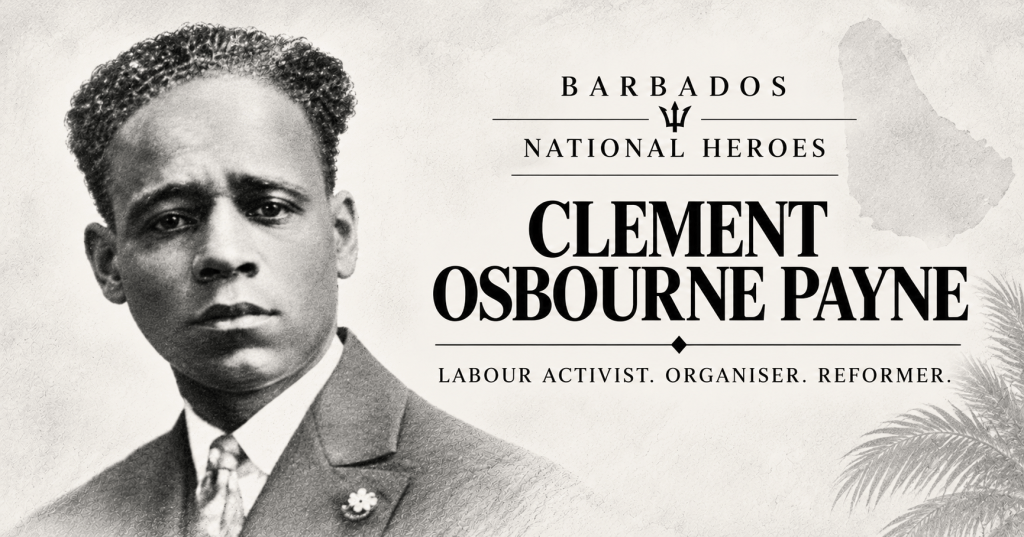
Adams’ political career accelerated during a period of real unrest in Barbados. In 1937, riots broke out on the island, triggered in part by the deportation of the labour activist Clement Payne — a figure so significant to this history that he’ll get his own post later in this series (week 6). Out of that unrest, Adams helped form the Barbados Progressive League in 1938, which soon became the Barbados Labour Party (BLP), one of the two parties that still dominate Barbadian politics today. Adams served as the party’s leader until 1941.
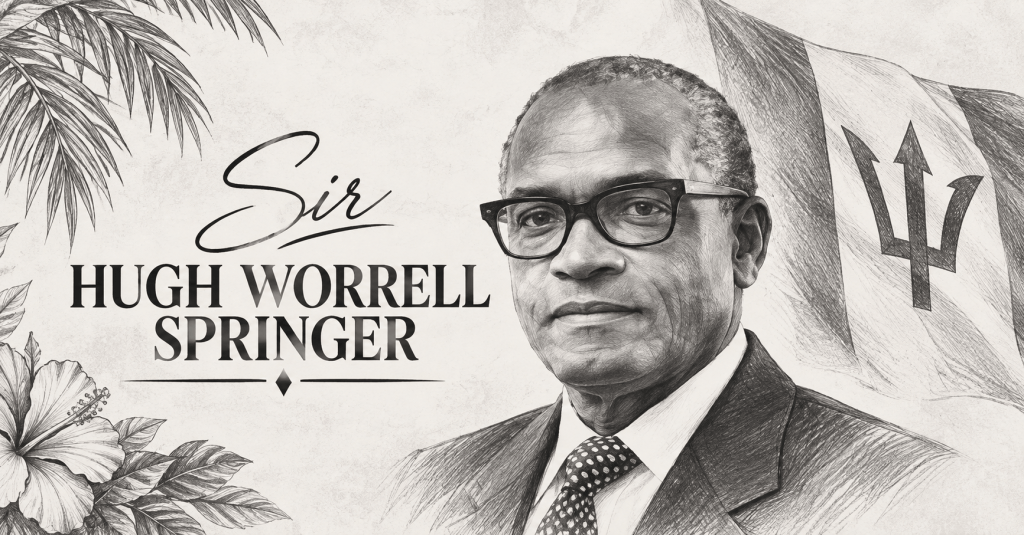
From there, Adams built influence across multiple fronts at once. From 1941 to 1954, he served as President of the Barbados Workers’ Union — an organization founded by fellow future National Hero Sir Hugh Worrell Springer (whose story comes later in this series). In 1947, he was elected President of the Caribbean Labour Congress in Jamaica, a role that connected him to labour and political movements across the wider English-speaking Caribbean, not just Barbados alone.
Dethroning the Plantocracy
Adams’ defining achievement was securing Universal Adult Suffrage for Barbados in 1951 — finally extending the vote to every adult Barbadian, regardless of property, income, or land ownership. It was the culmination of more than a century of struggle that this series has been tracing from the very beginning: from Prescod’s lonely fight to even sit in the Assembly, through O’Neal’s grassroots organising among the working class, to Adams finally tearing down the property qualification altogether.
In 1954, when full ministerial government was introduced in Barbados — meaning locally elected politicians, rather than colonial appointees, would actually run the government — Adams was elected as the island’s first Premier, a position he held until 1958. He was knighted in 1957 in recognition of his role in this transformation. Adams is widely credited with “dethroning the plantocracy,” ending, at last, the political dominance that the planter class had held onto since the earliest days of the colony, and setting Barbados firmly on the road toward the full independence it would achieve in 1966.
The West Indies Federation
Adams’s ambitions reached beyond Barbados alone. In 1958, he left Barbadian government to lead the newly formed West Indies Federation — a short-lived political union of ten English-speaking Caribbean territories, intended to give the region collective strength and a path toward independence as a single entity rather than as scattered small islands. Adams became its first, and ultimately only, Prime Minister.
The Federation proved difficult to hold together. Tensions grew between larger territories like Jamaica and Trinidad and the smaller islands over questions of representation and resources, and Adams faced criticism for what some saw as weak or indecisive leadership during this period. The Federation collapsed in 1962, and Adams returned to Barbadian politics, where the rival Democratic Labour Party (DLP) — founded partly on ideas that traced back to O’Neal’s original Democratic League — now held power. In 1966, Adams was re-elected to the House of Assembly representing St. Joseph and became Leader of the Opposition, remaining active in politics until his retirement.
Family Life and Later Years
In 1929, Adams married Grace Thorne, and the couple had one child, J.M.G.M. “Tom” Adams, who would go on to win the Barbados Scholarship himself, study law at Oxford just as his father had, and later become Barbados’ second Prime Minister in 1976 — five years after his father’s death. It’s a rare thing in any country’s history: a father-and-son pair who each, separately, led the nation.
Grantley Adams died on November 28, 1971, and was buried at the churchyard of the Cathedral Church of Saint Michael and All Angels in Bridgetown.
Legacy
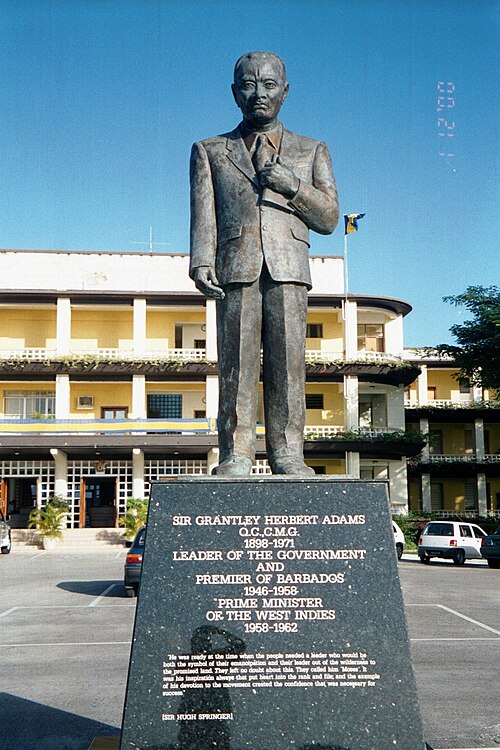
Barbados’ only international airport, Grantley Adams International Airport, was renamed in his honour in 1976, and a statue of him stands today in front of Government Headquarters on Bay Street. His image appears on the Barbadian $100 bill — the highest denomination note on the island. He also shares the ABC Highway, Barbados’s main highway, with two other honorees from this same series: his son Tom Adams and Errol Barrow, who will appear later as week 9.
Why Grantley Adams Is a National Hero
When Barbados named its ten National Heroes in 1998, Adams was honoured as, in the words of one tribute, the nation’s “Father of Democracy” — the man whose legal skill, political organising, and sheer persistence finally delivered universal suffrage and self-government to a colony that had spent centuries under the control of a small, wealthy elite. Where Prescod cracked the door open and O’Neal built the movement to push through it, Adams is remembered as the one who walked all the way through — and then kept walking, carrying the same fight onto the regional stage with the West Indies Federation.
Family Reflection
A few questions to talk through together this week:
- It took roughly a century — from Prescod’s election in 1843 to Adams’s suffrage reform in 1951 — for every adult in Barbados to get the vote. Why do you think change like this often takes so long?
- Adams tried to unite ten Caribbean islands into one federation, and it didn’t work out. What do you think makes it so hard for separate countries or islands to govern themselves as one?
- Grantley Adams and his son Tom Adams both became Prime Minister of Barbados. What do you think it might be like to grow up in a family with that kind of legacy?
Sources
- Grantley Herbert Adams — Wikipedia
- Barbados.org: Barbados National Heroes
- Totally Barbados: 1st Premier of Barbados — Sir Grantley Herbert Adams
- BlackPast.org: Grantley Herbert Adams (1898–1971)
- Oxford Reference: Sir Grantley Herbert Adams
Part of the “Barbados National Heroes” series on Child of the Caribbean.



Leave a Reply