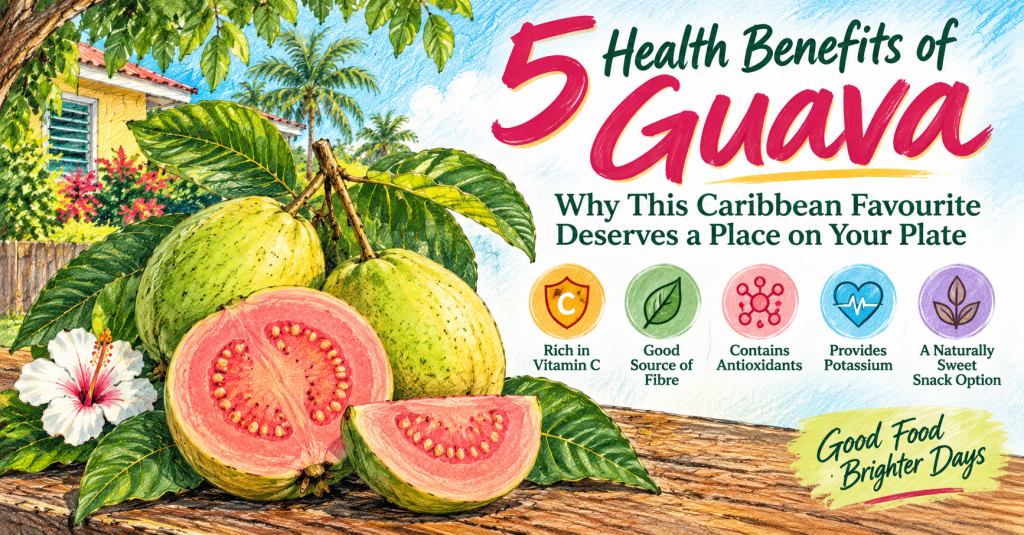
For many of us in the Caribbean, guava hardly needs an introduction. Its unmistakable fragrance can fill a kitchen before the fruit is even cut, and for generations it has been eaten straight from the tree or transformed into juice, jam, jelly, guava cheese and countless homemade treats.
The common guava, Psidium guajava, belongs to the myrtle family, Myrtaceae. Its origins lie in tropical America, although the precise original range of the cultivated species is debated. Today, guava is grown throughout tropical and subtropical regions of the world and has become firmly established across the Caribbean. (Plants of the World Online)
Guava may taste like a childhood treat, but it also has an impressive nutritional profile. Here are five reasons this familiar Caribbean fruit deserves a little more appreciation.
1. Guava Is an Excellent Source of Vitamin C
When we think about vitamin C, oranges and other citrus fruits usually come to mind first, but guava is also particularly rich in this important nutrient.
Vitamin C performs several important functions in the body. It supports normal immune function, helps the body form collagen, and acts as an antioxidant. This means that enjoying fresh guava can be an easy way to add vitamin C to a varied diet.
It also reminds us that nutritious food doesn’t always need to be imported or expensive. Sometimes an excellent source of vitamins is growing on a tree in the yard.
2. Guava Provides Dietary Fibre
Eating whole guava provides dietary fibre, which is important for a healthy digestive system. Fibre contributes to normal bowel function and can also help us feel fuller after eating.
This is one area where eating the whole fruit has an advantage over drinking heavily strained guava juice. When much of the pulp is removed during juicing, some of the fruit’s fibre is removed with it. That does not mean you have to give up a cold glass of guava juice, but eating the whole fruit allows you to benefit from more of its natural fibre.
Guava also brings back a very different childhood memory for me. I remember my grandmother making us drink guava-leaf tea whenever we were sick with diarrhoea. As children, we did not think about why she was giving it to us; it was simply one of those remedies Grandma knew, and we were expected to drink. Guava leaves have a long history of use in traditional medicine, including for digestive complaints, and researchers have investigated extracts of the leaves for possible antidiarrhoeal effects. However, that traditional use should not be confused with the dietary-fibre benefits of eating the fruit, nor should guava-leaf tea replace appropriate medical treatment, particularly when diarrhoea is severe or persistent.
Looking back, memories like this remind me that guava was more than something we picked from a tree and ate. Like many Caribbean plants, it formed part of the traditional knowledge our grandparents carried with them — knowledge that was often passed down around the kitchen table rather than written in a book.
Guava can therefore make a satisfying snack on its own or form part of a breakfast or fruit salad, while the stories surrounding the tree remind us just how deeply food, family and traditional Caribbean knowledge are connected.
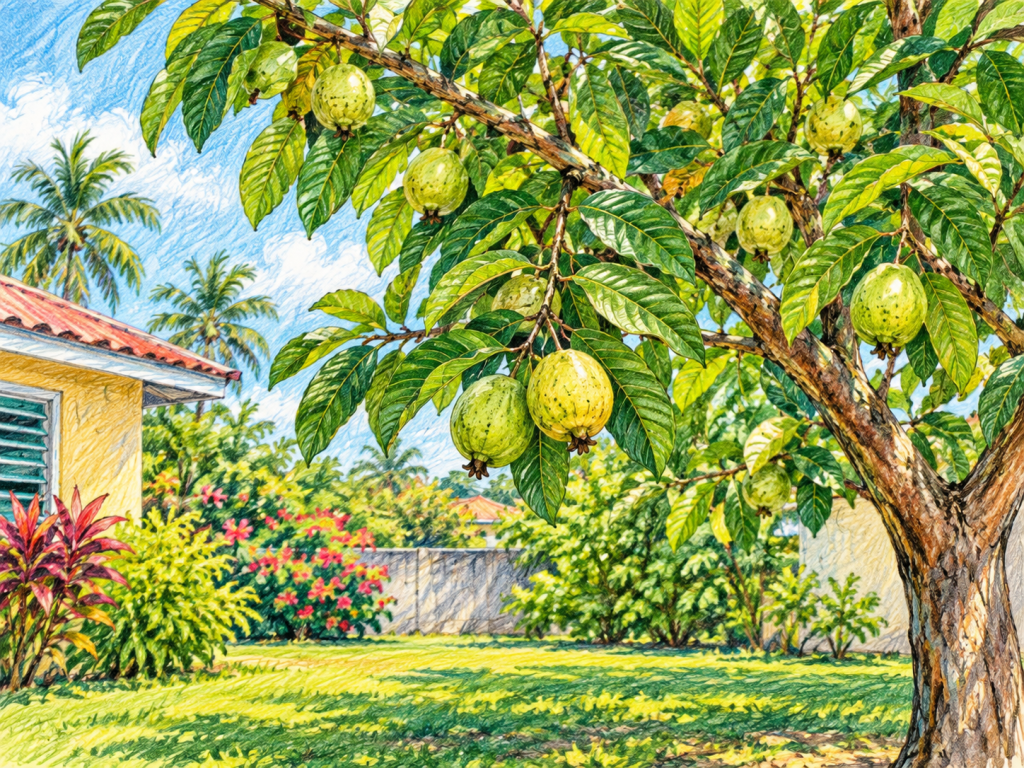
3. Guava Provides Antioxidant Plant Compounds
Guava contains a variety of naturally occurring plant compounds with antioxidant properties. Researchers continue to study guava fruit and other parts of the plant for their potential biological effects, including their antioxidant and anti-inflammatory properties. (PubMed)
Antioxidants help protect cells against oxidative stress, but it is important not to turn this into claims that guava can prevent or cure particular diseases. The evidence supports a much simpler message: eating a variety of fruits and vegetables supplies the body with useful nutrients and plant compounds, and guava can be part of that variety.
Pink and red-fleshed guavas are especially striking because their colour comes partly from naturally occurring pigments. Whether you prefer pink, white or cream-fleshed varieties, however, fresh guava can make a nutritious addition to your diet.
4. Guava Provides Potassium
Guava also provides potassium, an essential mineral needed by the human body. Potassium contributes to normal muscle and nerve function and plays an important role in maintaining normal fluid balance.
Rather than thinking of individual nutrients as miracle ingredients, it is better to look at guava as a package. When you eat the whole fruit, you are getting fibre, vitamins, minerals and plant compounds together.
That is one of the advantages of eating a varied selection of whole fruits rather than relying solely on supplements or heavily processed fruit products.
5. Guava Can Be a Naturally Sweet Alternative to Processed Snacks
Perhaps one of guava’s simplest health benefits is also one of its most practical. A ripe guava is naturally sweet while providing fibre and nutrients, making it a useful alternative when you want something sweet.
There is, however, an important distinction between fresh guava and everything made from guava. Guava jam, guava cheese, sweetened guava juice and other treats can contain considerable amounts of added sugar. They can certainly still be enjoyed as part of a balanced diet, but nutritionally they are not the same as eating the fresh fruit.
If health is your main consideration, enjoy guava close to its natural form whenever possible. Wash it, slice it and eat it — sometimes the simplest Caribbean traditions are difficult to improve upon.
Guava Is Nutritious, but It Isn’t a Miracle Cure
Traditional uses of guava and scientific interest in the plant have resulted in some impressive claims appearing online. Modern research is investigating various compounds found in guava fruit, leaves and other parts of the plant, including possible effects relating to inflammation, blood pressure and glucose metabolism. However, evidence from laboratory research or preliminary studies should not be interpreted as proof that eating guava will treat a medical condition. (PubMed)
There is no need to exaggerate guava’s benefits. The truth is already good enough: it is a nutrient-rich tropical fruit that provides vitamin C, fibre, potassium and useful plant compounds and can form part of a healthy, varied diet.
For Caribbean families, there is another benefit that does not appear on a nutrition label. Guava is a food connected to our environment and culinary heritage. Choosing locally grown fruit when available can support local farmers and help keep traditional Caribbean foods on our tables.
So the next time guava season comes around, don’t overlook that tree filled with fruit. Pick one, wash it and enjoy something generations of Caribbean people have enjoyed before us.
How do you prefer your guava — fresh from the tree, chilled, blended into juice or turned into something delicious? Tell us in the comments.
Child of the Caribbean
Sources
Royal Botanic Gardens, Kew — Plants of the World Online: Information on the taxonomy, origin, distribution and uses of Psidium guajava. (Plants of the World Online)
Read the Kew Plants of the World Online entry for guava
Royal Botanic Gardens, Kew: Botanical reference material notes that the original distribution of guava is uncertain but places its probable origins in tropical America and records its modern cultivation throughout tropical and subtropical regions. (Kew Gardens)
Butt, E. et al. (2025), Food Chemistry: X: Scientific review of Psidium guajava, its bioactive compounds and research into its potential health properties. Available through the U.S. National Library of Medicine’s PubMed database. (PubMed)
Read the guava review on PubMed








Leave a Reply