Category: Barbados National Heroes
Week: 2 of 11
Years: 1795–1866
Setting the Scene: Religion and Race in Early 1800s Barbados
By the early 19th century, the Church of England held a near-total grip on religious life in Barbados, and that grip was deeply tied to the social order of slavery itself. The established church was, in practice, a white planter institution. When Methodist missionaries arrived on the island in 1788, led by Dr. Thomas Coke, they brought something the plantation class found threatening: a faith that welcomed enslaved and free Black and mixed-race Barbadians as full members, and preachers who were increasingly associated — fairly or not — with the growing anti-slavery movement in Britain.
By 1793, the island’s white upper classes had come to view Methodists with open suspicion, treating missionaries as agents of the England-based Anti-Slavery Society rather than simply religious figures. That suspicion would eventually boil over into violence — and it’s within that boiling point that Sarah Ann Gill’s story becomes central to Barbadian history.
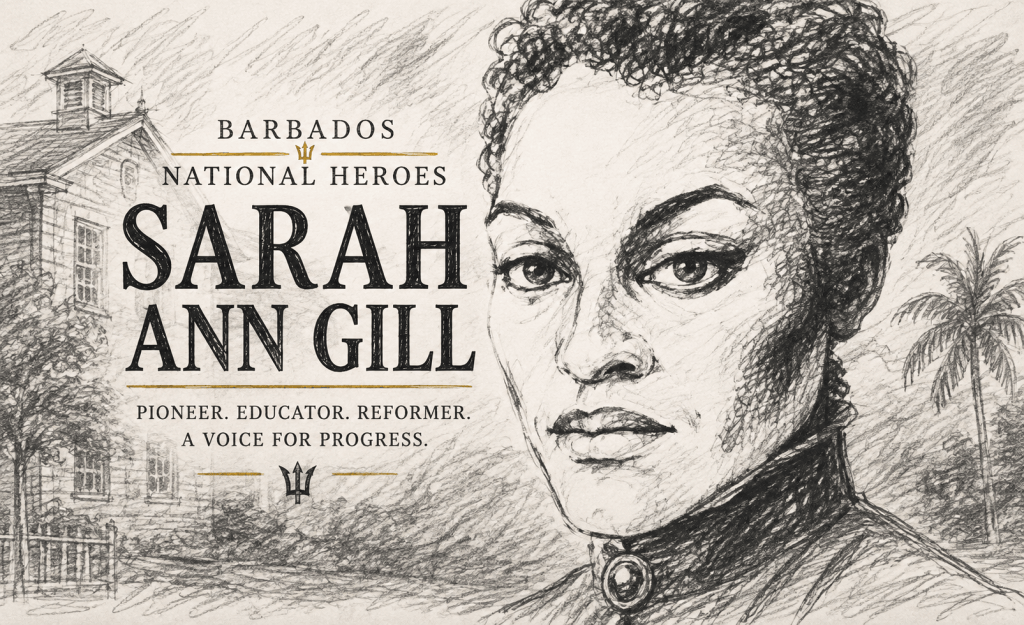
Who Was Sarah Ann Gill?
Sarah Ann Gill was born on February 16, 1795, to a Black mother and a white father, and baptized simply as “Ann.” In the racial hierarchy of the time, her mixed ancestry placed her in the “Free Coloured” class — legally free, but still barred from full participation in the island’s social, political, and economic life. Barbadian society at the time operated on the belief that any trace of African ancestry made a person inherently subordinate to those of “pure” European descent, regardless of legal freedom.
Little is documented about Gill’s early life. What the historical record picks up clearly is her religious journey: she was drawn to Methodism, made a ten-pound donation in 1819 toward building Bridgetown’s first stone Methodist chapel, and by 1820 was recognized as a full member of the church. The name “Sarah” was reportedly given to her later by the Methodist community itself, in recognition of the role she would go on to play — a nod to the biblical Sarah, and to the vital place Gill would come to hold in establishing a genuine religious alternative to the white-dominated Church of England in Barbados.
The Crisis of 1823
Tensions between the plantation elite and the Methodist community reached a breaking point in October 1823, when a mob of white rioters destroyed the Methodist chapel in Bridgetown. The resident missionary, Reverend William Shrewsbury, and his pregnant wife were forced to flee the island for their lives, escaping to St. Vincent. With the chapel gone and the missionary driven out, the Methodist congregation in Barbados was left with no building, no minister, and open hostility from the colonial authorities.
This is the moment Sarah Ann Gill stepped forward. Along with her sister-in-law, Christiana Gill, she opened her own home as a makeshift church, allowing the congregation to keep meeting and keep worshipping despite having lost their chapel. It was an extraordinarily dangerous decision. Barbados still operated under the 17th-century Conventicles Act, a law originally aimed at suppressing unauthorized religious gatherings, and colonial authorities used it against Gill directly.
For roughly a year, Gill endured sustained persecution for her refusal to stop hosting the congregation. She received repeated threats of violence and warnings that her home would be burned down. At one point, shots were reportedly fired at her house. She was questioned by magistrates who accused her of secretly stockpiling guns and ammunition, and she was ultimately formally prosecuted by the House of Assembly itself — the island’s governing body — for continuing to hold religious meetings.
Gill did not back down. She kept her home open as a place of worship throughout the ordeal, effectively keeping Methodism alive in Barbados during the period when the church had no official standing, no building, and no protection.
The Aftermath and Her Later Legacy
The persecution campaign against Gill and the Methodist congregation eventually eased, and the church was able to reestablish itself on the island. Gill herself is remembered as instrumental in that survival — without her willingness to risk her home, her safety, and her legal standing, the Methodist presence in Barbados might well have been extinguished entirely in the 1820s.
She lived the rest of her life in Barbados, continuing her association with the church she had helped preserve, and died on February 25, 1866, at the age of 71. She’s buried in the small churchyard behind the James Street Methodist Church in Bridgetown — a church that exists today, in no small part, because of her. Her headstone, revised during Barbados’s 1988 Heritage Year, identifies her plainly as the “Heroine of Methodism in Barbados” and “the Defender of Methodism when its existence was threatened in 1823–1825.”
Why Sarah Ann Gill Is a National Hero
When Barbados’s Order of National Heroes was established by an act of Parliament in 1998, Sarah Ann Gill was named among the original ten — and she the first woman among them. Her recognition reflects something broader than a single act of religious defiance: she represents the fight for freedom of conscience and worship at a time when the colonial establishment tried to control not just enslaved people’s labour, but their spiritual lives as well. Several churches on the island, including the Gill Memorial Methodist Church, carry her name today in tribute.
Her story also stands out for what it adds to the wider National Heroes narrative. Where Bussa’s story (week one of this series) is one of armed uprising, Gill’s is one of quiet, sustained, personal defiance — opening her own front door, again and again, in the face of real threats to her life, simply to keep a community’s faith alive.
Family Reflection
A few questions to talk through together this week:
- Sarah Ann Gill resisted through faith and quiet persistence rather than open rebellion. Why do you think both kinds of resistance matter in a country’s history?
- She kept opening her home even after receiving threats and having shots fired at it. What do you think gave her the courage to keep going?
- Barbados named ten National Heroes in 1998, and Gill was the only woman. Why do you think stories like hers can sometimes get overlooked compared to more “dramatic” ones like rebellions or wars?
Sources
- Sarah Ann Gill — Wikipedia
- Totally Barbados: Sarah Ann Gill — National Hero of Barbados
- Black Then: Bajan Hero Against Religious Persecution — Sarah Ann Gill
- Caribbean National Weekly: Sarah Ann Gill Held Firm to Her Beliefs
- A Bajan Tour Girl Exploring Barbados: National Hero Sarah Ann Gill
Part of the “Barbados National Heroes” series on Child of the Caribbean.



Leave a Reply