Setting the Scene: Barbados Before 1816
By the early 1800s, Barbados had been a British sugar colony for nearly 200 years, and its economy ran almost entirely on the forced labour of enslaved Africans. Sugar plantations covered most of the usable land on the island — unlike Jamaica, which still had mountains and forests where escaped or resisting enslaved people could hide, Barbados was small, flat, and thoroughly cultivated. There was, quite literally, nowhere to run. The island also had a comparatively large and well-armed white militia for its size, which made open rebellion an especially dangerous gamble.
Resistance still happened constantly, just often in quieter forms: enslaved people slowed down work, damaged tools, kept their own languages and rituals alive in private, or pretended to accept Christianity while practising their own beliefs. But by 1816, conditions and rumours converged to produce something far bigger.
Who Was Bussa?
Bussa — sometimes recorded in historical documents as Busso or Bussoe — is honoured today as the first of Barbados’s National Heroes and the figure most closely associated with the largest slave uprising in the island’s history. Almost nothing is documented about his early life, and historians still debate his exact origins. He may have descended from the Coromantee people of the Gold Coast (in present-day Ghana), the Igbo people of what is now south-eastern Nigeria, or possibly both, since the ancestry of enslaved Barbadians by this period often blended multiple West African backgrounds through generations of forced relocation and intermixing on the island.
What the historical record does confirm is that Bussa held the position of “ranger” on Bayley’s Plantation in the parish of St. Philip. A ranger was one of the more senior roles available to an enslaved person — someone trusted to manage estate boundaries and fences, resolve day-to-day matters between neighbouring plantations, and travel relatively freely across the surrounding area. That mobility and relative trust from plantation management likely gave Bussa both the standing among enslaved communities and the practical opportunity to help organise a coordinated uprising across multiple estates.
It’s worth being honest about how thin the historical record actually is here. Some historians, notably Jerome Handler, have argued that calling the uprising “Bussa’s Rebellion” overstates his individual role, since contemporary sources describe him as only one of several organisers rather than a singular commander. Others, like historian Hilary Beckles, have pushed back and defended Bussa’s status as the recognised leader. Barbados’s National Heroes designation reflects the latter view, but it’s a genuinely debated point among historians, and it’s part of what makes his story interesting to dig into rather than just accept at face value.
Planning the Uprising
Bussa didn’t act alone. The rebellion was planned across several estates and involved a small network of enslaved organisers, including Jackey, a driver at the Simmons estate; King Wiltshire, a carpenter at Bayley’s; and Nanny Grigg, a literate enslaved domestic worker at Simmons who is believed to have helped circulate word of the plan and may have influenced its timing.
Timing mattered a great deal. Britain’s Parliament had already banned the transatlantic slave trade in 1807 — though this outlawed the trade in enslaved people, not slavery itself. By 1815, a “Slave Registry Bill” was being debated in the British Parliament, intended mainly to track and regulate the enslaved population. Word reached Barbados that this bill meant freedom was coming. When Governor James Leith returned to the island from Guadeloupe around this time, many enslaved Barbadians believed he was carrying a “free paper” that would formally end slavery. When no such freedom arrived, the sense of betrayal fed directly into the decision to act.
The Rebellion: April 14–16, 1816
The uprising began on the night of Easter Sunday, April 14, 1816, starting at Bayley’s Plantation and spreading rapidly — by some estimates, roughly a third of the island’s cultivated land was affected within days, and around 5,000 enslaved people took part in some form, with an estimated 400 actively engaged in fighting. Sugar cane fields were set ablaze across multiple estates as both an act of destruction against plantation wealth and a signal that spread the revolt from property to property.
The British colonial response was swift and overwhelming. Roughly 800 militia and regular troops, backed by artillery, moved to suppress the uprising within about three days. Bussa was killed in the fighting at Bayley’s, and organised resistance collapsed shortly after his death. On the colonial side, casualties were remarkably light — one soldier and one civilian were killed in total. On the other side, the toll was severe: around 50 enslaved people were killed in the fighting itself, roughly 214 were formally executed in the aftermath (many after summary trials), and around 170 more were exiled from the island. Many others were mutilated or punished as a warning to the rest of the enslaved population.
The rebellion also had a political side effect the colonial elite hadn’t anticipated: white planters largely blamed Christian missionaries for spreading ideas of equality and freedom among enslaved people, and reacted by destroying chapels and banishing missionaries such as William Shrewsbury from the island. Ironically, this backlash helped shift public opinion in Britain itself further toward abolition, as reports of the harsh reprisals circulated back home.
The Long Road to Freedom
Bussa’s Rebellion did not bring immediate freedom — slavery in the British Caribbean continued for nearly two more decades. It wasn’t until the Slavery Abolition Act of 1833 that emancipation was formally legislated, taking effect in phases from 1834, with full freedom for formerly enslaved people in Barbados only completed by 1838. When that day finally came, it’s recorded that thousands of Barbadians took to the streets chanting in celebration, greeting Queen Victoria as the monarch under whom freedom had come.
Historians generally view the 1816 uprising as an important, if costly, milestone on that longer road — a demonstration to the British public that enslaved people themselves were actively fighting for freedom, not passively waiting for it to be granted.
Why Bussa Is a National Hero
When Barbados established its Order of National Heroes in 1998, ten individuals were named, and Bussa was the only one honoured for actions taken during slavery itself — making him, symbolically, first in the series both by historical chronology and by official designation. He’s remembered not for winning the rebellion militarily, but for the willingness to organise, resist, and risk everything for freedom in a system explicitly built to make that nearly impossible.
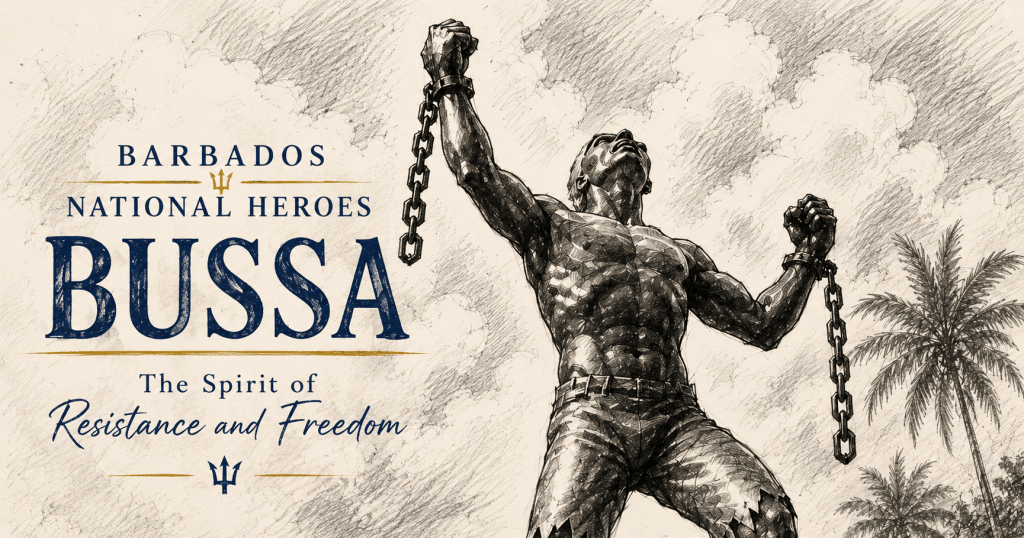
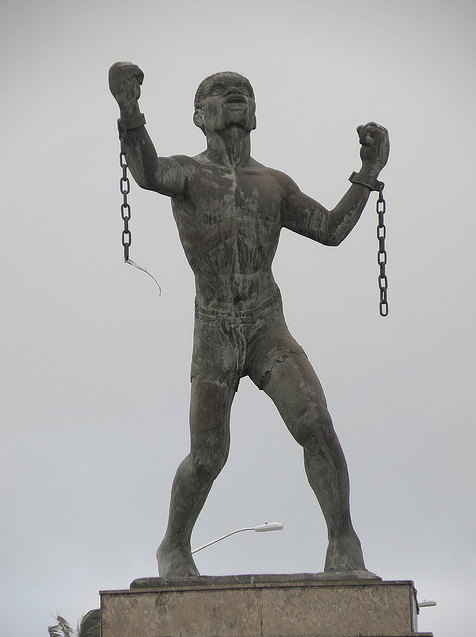
His memory is now most visibly tied to the Emancipation Statue — commonly just called “Bussa” by Barbadians — a bronze sculpture created in 1985 by Barbadian-Guyanese artist Karl Broodhagen, located at a roundabout on the ABC Highway near Bridgetown. Interestingly, the statue isn’t actually a literal depiction of Bussa himself; it’s a symbolic figure with raised arms and broken chains, representing the breaking of slavery more broadly, though it has become permanently linked with his name and story in the public imagination. It stands today as one of the most recognised and photographed monuments in Barbados, and has been the site of significant political moments — including a notable 1998 visit and speech by Cuban President Fidel Castro.
Family Reflection
A few questions to talk through together this week:
- What do you think it took for Bussa, Nanny Grigg, King Wiltshire, and the others to plan this in secret, knowing the risk if they were caught?
- Why might Barbados have chosen to make Bussa its first National Hero, even though the rebellion itself was defeated within days?
- Historians disagree about how much credit Bussa individually deserves versus the wider group of organisers. Why do you think it matters (or doesn’t) exactly who “led” the rebellion?
- Have you seen the Emancipation Statue, or photos of it? What do you think it’s meant to make people feel when they see it?
Sources
- Bussa’s Rebellion — Wikipedia
- Order of National Heroes — Wikipedia
- Emancipation Statue — Wikipedia
- The National Archives (UK): Bussa’s Rebellion education resource
- GlobalSecurity.org: Bussa’s Rebellion overview
Part of the “Barbados National Heroes” series on Child of the Caribbean.



Leave a Reply