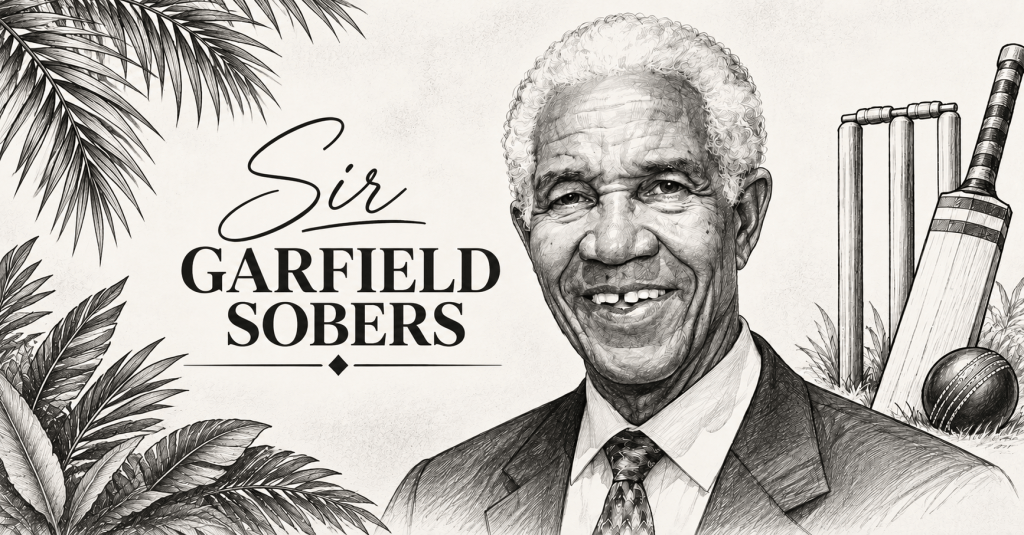
Category: Barbados National Heroes Week: 10 of 11 Years: 1936–2026
Setting the Scene: A Newly Confident Nation
By the time Garfield Sobers was coming of age in the 1950s, Barbados was in the middle of the long political transformation this series has been tracing — universal suffrage had just arrived, the labour movement was maturing, and independence was still over a decade away. Cricket, meanwhile, had long been one of the few arenas where Black Caribbean talent could compete directly against, and beat, the old colonial powers on an equal footing, in full view of the world. A gifted West Indian cricketer wasn’t just playing a sport — they were carrying something close to national pride onto an international stage, years before the islands had full political independence of their own.
Into that world stepped a teenager from a working-class Bridgetown family who would go on to become, by broad consensus, the greatest all-rounder the game of cricket has ever produced.
Who Was Garfield Sobers?
Garfield St Aubrun Sobers was born on July 28, 1936, in Bridgetown, Barbados, to Shamont and Thelma Sobers of Bay Land, St Michael — the fifth of six children. From an early age he showed natural talent for almost any sport involving a ball, but cricket is where that talent truly took hold. At just 13, he was recruited to play for the Kent St Philip club in the Barbados Cricket League, while also training with the Wanderers club of the Barbados Cricket Association.
Sobers made his first-class debut for Barbados at the age of 16, against the touring Indian team at Kensington Oval in Bridgetown — originally selected as a slow left-arm bowler, batting at number nine, a modest starting point for a career that would soon become anything but modest. Just over a year later, at 17, he made his Test debut for the West Indies against England at Sabina Park in Kingston, Jamaica. Within two seasons, he had been promoted all the way up the order to open the batting for his country.
A Career Without Equal
Sobers’s Test career ran from 1954 to 1974, and the numbers alone tell an extraordinary story: 8,032 Test runs at a batting average of 57.78, alongside 235 Test wickets — the kind of dual output, as both a world-class batsman and a genuinely dangerous bowler, that very few cricketers in history have managed at the same time. It’s this rare combination that earns him his enduring title as cricket’s greatest all-rounder.
A handful of individual moments stand out even within that extraordinary career. In 1958, at just 21, Sobers became the youngest player ever to break cricket’s individual Test scoring record, with an unbeaten 365 against Pakistan — a record that stood for decades, and he remains to this day the youngest player to score a Test triple-century. In the famous “Tied Test” against Australia at Brisbane in 1960–61 — one of the most celebrated matches in cricket history — Sobers scored 132 in just 123 minutes, an innings the respected cricket writer Jack Fingleton called one of the greatest he had ever witnessed. A decade later, playing for the Rest of the World side against Australia at Melbourne in 1971, Sobers scored 254 runs in an innings that the legendary Australian batsman Sir Donald Bradman himself called probably the best ever seen on Australian soil.
Sobers went on to captain the West Indies team, and he also built a respected county cricket career in England with Nottinghamshire, where he was appointed captain and led the club from near the bottom of the table to genuine competitiveness, topping the batting averages in his very first season.
Off the Field
Sobers’ influence extended beyond his own statistics. In 1969, he became one of the first prominent international cricketers to push for the integration of apartheid-era South Africa into world cricket — a stance that drew both fierce criticism and praise, reflecting the genuinely fraught politics of sport, race, and South Africa at the time. He also dedicated time to coaching Black youth, and later took on international coaching roles, including a stint with Sri Lanka’s national team.
He was also a published author, writing several books on the game, including the novel Bonaventure and the Flashing Blade (1967).
Honours
Sobers retired from cricket in 1974 due to a knee injury, closing out a 20-year international career. The following year, in 1975, Queen Elizabeth II knighted him for his services to cricket — notably, the ceremony took place at the Garrison Savannah in Barbados rather than at Buckingham Palace, a detail itself seen as an honour to his homeland. In 1984, he was inducted into the USA Cricket Hall of Fame, and in 2007, the cricket almanack Wisden retrospectively named him the Leading Cricketer in the World for eight separate years, dating back across the entire 20th century.
The Garfield Sobers Stadium in Barbados stands as a lasting monument to his legacy, and the International Cricket Council’s annual Cricketer of the Year award is presented as the Sir Garfield Sobers Trophy — his name now permanently attached to the sport’s highest individual honour.
Sobers passed away in Saint Michael, Barbados, on July 17, 2026, at the age of 89 — just eleven days before what would have been his 90th birthday.
Why Garfield Sobers Is a National Hero
When Barbados named its National Heroes in 1998, Sobers was honoured as a figure who carried Barbadian pride onto the world stage at a time when the island was still finding its political feet. Where the other heroes in this series fought through rebellion, religion, journalism, politics, and organised labour, Sobers’s contribution came through sheer sporting excellence — but the effect was much the same: proof, delivered on cricket grounds from Brisbane to Melbourne to Lord’s, that Barbadian talent could stand at the very top of the world, matching and often surpassing the old colonial powers on their own game.
Family Reflection
A few questions to talk through together this week:
- Sobers became a national hero through sport, not politics or activism. Why do you think excelling on the world stage can matter so much to a small nation’s sense of identity?
- In 1969, Sobers took a public stand on South African cricket that drew criticism as well as praise. Why do you think sports figures sometimes choose to speak out on political issues, even when it’s risky?
- Sobers’s knighthood ceremony was held in Barbados instead of London. Why do you think that detail might have mattered, both to Sobers and to Barbadians watching?
Sources
- Garfield Sobers — Wikipedia
- Totally Barbados: Sir Garfield Sobers — National Hero of Barbados
- Barbados.org: Sir Garfield Sobers
- Trent Bridge: Sir Garfield Sobers
- Cricket Hall of Fame: Sir Garfield Sobers
Part of the “Barbados National Heroes” series on Child of the Caribbean.



Leave a Reply