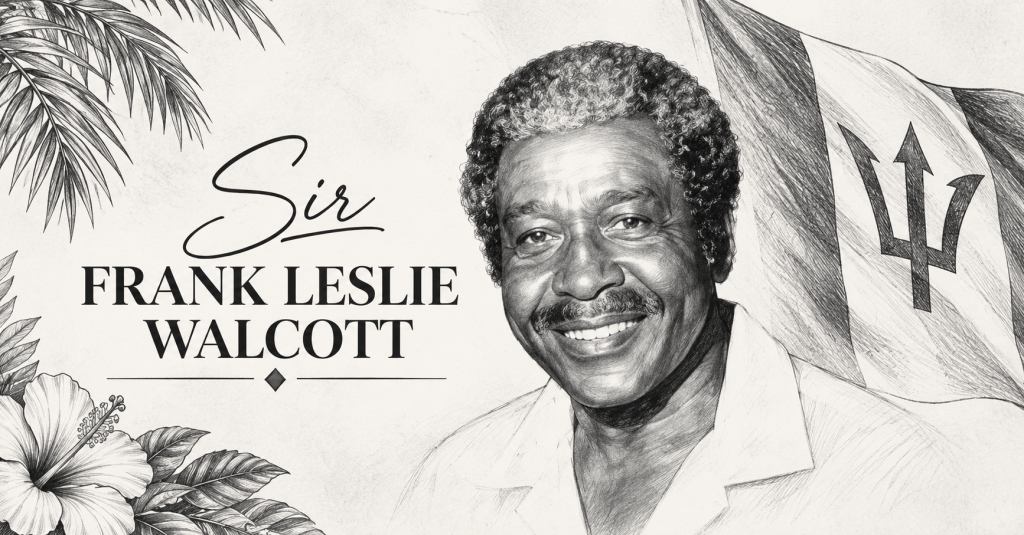
Category: Barbados National Heroes Week: 8 of 11 Years: 1916–1999
Setting the Scene: A Union Looking for Its Next Leader
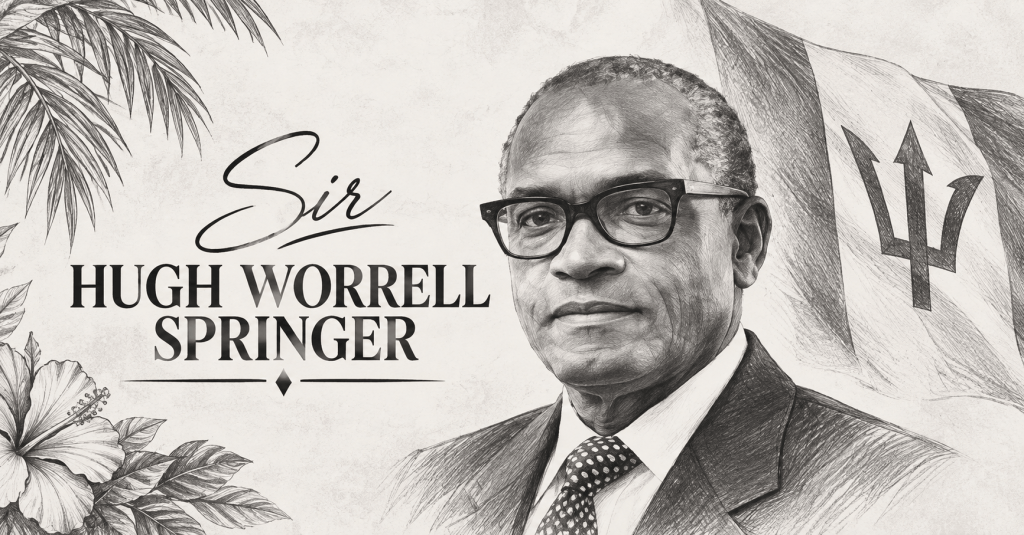
By the mid-1940s, the Barbados Workers’ Union — built in the wake of the 1937 riots by Hugh Springer (week 7) and championed politically by Grantley Adams (week 5) — was still a young institution, feeling out exactly how much power organized labour could wield in Barbados. It had leadership and direction, but it needed someone who could stay in the trenches for the long haul: negotiating contracts, managing the union’s day-to-day operations, and keeping workers’ concrete, material concerns — wages, housing, insurance — at the center of the movement for decades, not just years.
That person turned out to be a young man from St. Peter who would go on to spend nearly half a century doing exactly that.
Who Was Frank Walcott?
Frank Leslie Walcott was born on September 16, 1916, in the parish of St. Peter, Barbados. His early life was shaped by loss and hardship: his father, a policeman, died while Frank was still very young, leaving his mother, Marian Walcott, to raise him largely on her own. She worked first as a plantation labourer and later moved the family to Bridgetown, where she found work as a domestic helper. Frank was raised in Bridgetown and attended Wesley Hall Boys’ School.
By most accounts, Walcott showed early promise as a skilled mathematician, with a sharp, combative debating style that would serve him well in a career built almost entirely around negotiation. He summed up his own personality simply and memorably: “Frank by name and Frank by nature.”
Joining the Labour Movement
Impressed by his talents, the leaders of the Progressive League — Hugh Springer and Grantley Adams — invited Walcott to join the movement. On January 1, 1945, he became Assistant to the General Secretary of both the Progressive League and the Barbados Workers’ Union. By March 1946, he was fully employed by the BWU, Barbados’s first trade union, beginning what would become a 45-year career as an employee of the organization.
The turning point came in October 1947, when Hugh Springer stepped down from the union to become Registrar of the newly forming University College of the West Indies. Walcott was appointed to act as General Secretary on November 5, 1947, and was formally confirmed in the role the following year — a position he would go on to hold for an astonishing 44 years, until 1991.
Walcott, Working for Workers
As General Secretary, Walcott transformed the Barbados Workers’ Union from a young, still-proving-itself organisation into a sophisticated, respected institution at home and abroad. Under his leadership, the union helped institutionalise industrial relations in Barbados, successfully lobbied for labour and social legislation, established a credit union for its members, strengthened its internal bureaucracy, and constructed modern physical facilities, including a labour college and housing for union members.
Among his most significant concrete achievements were his contributions to Barbados’ National Insurance Scheme and the introduction of maternity leave protections — benefits that working Barbadians, including mothers, still rely on today. His influence was also felt annually through the union’s May Day celebrations, which Walcott used as a platform to address the pressing industrial relations issues of the moment and to state the union’s position in unequivocal terms — an event still regarded as one of the most important dates on the Barbadian labour calendar.
Walcott was also politically active in his own right, serving as a Member of Parliament in the House of Assembly, representing the Democratic Labour Party from 1945 to 1966 and again from 1971 to 1976. Notably, he broke politically with Grantley Adams in 1954 and became an independent — even as the two men’s institutions, the BLP and the BWU, remained closely intertwined. It’s a reminder that the labour and political wings of this broader movement, while connected, weren’t always perfectly aligned, even among people who had worked side by side for years.
International Standing
Walcott’s influence extended well beyond Barbados’ shores. He served as President of the Caribbean Congress of Labour across three separate terms — 1960–1963, 1966–1969, and 1977–1980 — and sat as a member of the governing body of the International Labour Organisation, representing Caribbean workers on a genuinely global stage.
When Barbados gained independence in 1966, Walcott was chosen as the nation’s first Ambassador to the United Nations — a striking vote of confidence in a man whose career had begun not in diplomacy, but in the gritty, day-to-day work of union negotiation.
Honours and Later Life
Walcott’s contributions were formally recognised throughout his life. He received the Order of the British Empire (OBE) in 1954 for his service to the country, and in 1987, he was conferred Barbados’ highest honour, becoming a Knight of St. Andrew (KA).
Walcott became unwell in 1992 and stepped down as leader of the BWU, handing the role to his longtime deputy, Roy Trotman, who had worked under him since 1971. Walcott died on February 24, 1999, at the age of 82, closing out a public life that had spanned more than five decades of service to Barbadian workers.
Legacy
The Sir Frank Walcott Building in St. Michael, Barbados, stands today as a lasting tribute to his work, alongside recognition from the Barbados Workers’ Union, the Hugh Shearer School for Labour Studies, and the University of the West Indies, Cave Hill. A dedicated archival collection at UWI continues to preserve his papers and legacy for researchers and the public.
Why Frank Walcott Is a National Hero
When Barbados named its National Heroes in 1998, Walcott was honored for the sheer staying power and consistency of his advocacy: 45 years with a single union, 44 of them as its General Secretary, defending Barbadian workers through changing governments, economic conditions, and political alliances. Where Hugh Springer built the institution and Grantley Adams carried its political fight to Parliament, Walcott is remembered as the one who stayed at the negotiating table, year after year, turning the hard-won gains of 1937 into lasting, concrete protections like national insurance and maternity leave that still shape Barbadian working life today.
Family Reflection
A few questions to talk through together this week:
- Walcott spent 45 years working for a single union. What do you think it takes to stay committed to one cause for that long?
- He was raised by a single mother who worked as a domestic helper, and went on to represent Barbados at the United Nations. What do you think that journey says about him?
- Walcott broke politically with Grantley Adams in 1954, even though their organisations remained closely linked. Why do you think it’s possible — and sometimes necessary — to disagree with someone you’ve worked closely with?
Sources
- Frank Leslie Walcott — Wikipedia
- Totally Barbados: Sir Frank Leslie Walcott — National Hero of Barbados
- Encyclopedia.com: Walcott, Frank
- Barbados Pocket Guide: Sir Frank Walcott
- UWI Space: Frank Walcott Collection
- Barbados Government Information Service: Let’s Celebrate Our National Heroes
Part of the “Barbados National Heroes” series on Child of the Caribbean.




Leave a Reply