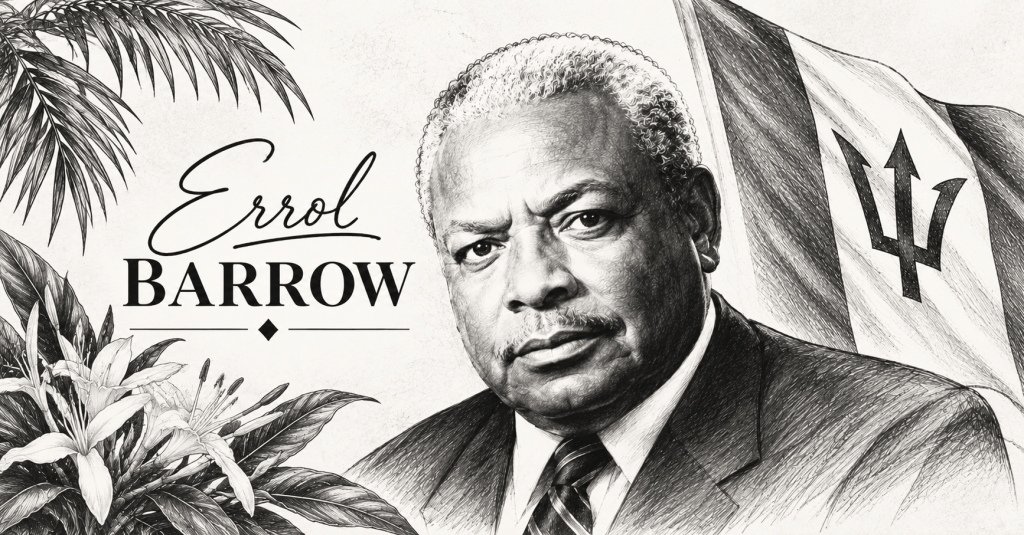
Category: Barbados National Heroes Week: 9 of 11 Years: 1920–1987
Setting the Scene: A Nation on the Verge
By the start of the 1960s, Barbados had already come a long way from the colony this series opened with. Universal Adult Suffrage had arrived in 1951, thanks largely to Grantley Adams (week 5). A functioning union movement, built by Hugh Springer (week 7) and sustained for decades by Frank Walcott (week 8), was protecting workers’ rights. The West Indies Federation had risen and then collapsed in 1962, leaving Barbados — like its island neighbours — to decide what came next on its own.
What Barbados still didn’t have was full independence. That final step would be led by a man who, remarkably, was related by blood to two heroes already covered in this series.
Who Was Errol Barrow?
Errol Walton Barrow was born on January 21, 1920, in the parish of St. Lucy, Barbados, to Reginald Grant Barrow and Ruth Alberta Barrow (née O’Neal). His family connections to this series run deep: Ruth’s nephew — her sister’s son — was Charles Duncan O’Neal (week 4), the physician and activist who founded the Democratic League and laid much of the groundwork for Barbadian party politics. And among Errol’s childhood playmates at his grandmother’s house on Crumpton Street was his cousin, Hugh Springer (week 7) — later Sir Hugh, Governor-General of Barbados, and, like Barrow, a National Hero in his own right. By the time Barrow entered public life, he was already connected, by family, to two of the very movements this series has traced from the beginning.
Barrow attended Wesley Hall Boys’ School before winning a scholarship that took him further afield.
War Service
In December 1940, as the Second World War raged in Europe, Barrow enlisted in the Royal Air Force alongside eleven other Barbadians who became known as “The Second Barbadian Contingent.” He trained as a navigator and went on to fly 48 operational combat sorties between September 1944 and March 1945, logging over 103 hours of combat flying time. He remained with the RAF until 1947 — service that would have been dangerous and demanding by any measure, and that gave the future statesman firsthand experience of Britain not as a distant colonial authority, but as a country he had personally fought for.
After leaving the RAF, Barrow stayed in Britain to study Economics and Industrial Law at the London School of Economics and Political Science, before finally returning home to Barbados in November 1950 to practise as a lawyer.
Founding the DLP
Barrow’s political career began to take real shape in 1955, when he founded the Democratic Labour Party (DLP) to press for social and political reform and for independence from British rule. He became the party’s chairman, and in 1961, the DLP won the general election, with Barrow becoming the third Premier of Barbados.
Leading Barbados to Independence
What followed was a remarkably fast transformation. In just five years as Premier, Barrow led Barbados through the final steps toward full independence from Great Britain. On the night of November 30, 1966, the Union Jack was lowered and the Barbadian flag raised for the first time — and Errol Barrow, wearing his old RAF mess dress jacket and medals, became the first Prime Minister of an independent Barbados. He would go on to serve two terms in that role, until September 1976.
For this achievement, Barrow is remembered across Barbados simply as the “Father of Independence.”
Building a Modern Nation
Barrow’s time as Prime Minister wasn’t only about the symbolic act of independence — his governments reshaped Barbadian daily life in lasting, practical ways. He introduced free secondary education for all Barbadian children, a policy with roots stretching back to the reforms Charles Duncan O’Neal had championed decades earlier but never lived to see enacted. He established National Health Insurance and a modern social security system, lowered the voting age from twenty-one to eighteen, and modernized the island’s electoral system.
Barrow also looked outward. He accelerated industrial development and expanded the tourism industry into what would become a central pillar of the Barbadian economy. He co-founded regional organizations including CARIFTA (the Caribbean Free Trade Association) and later CARICOM (the Caribbean Community), continuing — in a different form — the vision of Caribbean unity that Grantley Adams had pursued through the West Indies Federation. Under Barrow, Barbados also joined both the United Nations and the Organization of American States, and he helped establish the University of the West Indies’ presence in Barbados. Later in his tenure, he pulled Barbados out of the Eastern Caribbean Currency Authority and introduced the independent Barbados dollar.
Defeat, Opposition, and Return
Barrow’s DLP lost power in 1976, and he spent the following decade as Leader of the Opposition — nearly ten years out of government. Then, in May 1986, in a remarkable political comeback, Barrow was overwhelmingly re-elected Prime Minister, becoming Barbados’s fourth Prime Minister as well as its first.
He did not get to serve long in this second term. Errol Barrow died suddenly, in office, on June 1, 1987, at the age of 67.
Legacy
Barrow’s likeness appears on the Barbadian $50 banknote, and his birthday, January 21, is now observed as a national holiday. He is also remembered as the creator of the Barbados Community College. The Errol Barrow Day holiday and numerous public institutions across the island continue to carry his name and legacy forward.
Why Errol Barrow Is a National Hero
When Barbados named its National Heroes in 1998, Barrow was honoured as the figure who finally carried the island across the finish line this entire series has been tracing — from Bussa’s rebellion against slavery, through Prescod’s fight for political representation, O’Neal’s grassroots organizing, Adams’s achievement of universal suffrage, and the labour movement built by Springer and Walcott — to full national independence. Barrow is remembered not just for the moment the flag was raised, but for the practical, everyday institutions — free education, national health insurance, social security — that gave independence real substance in the lives of ordinary Barbadians.
Family Reflection
A few questions to talk through together this week:
- Errol Barrow was related to both Charles Duncan O’Neal and Hugh Springer. What do you think it says about Barbados’s path to independence that so much of it ran through a handful of connected families and communities?
- Barrow served in the RAF and fought for Britain during WWII, then later led his country to independence from that same Britain. How do you think those two chapters of his life might be connected?
- After nearly ten years as Opposition Leader, Barrow was re-elected Prime Minister in 1986. What do you think it takes to keep going in public life after a long stretch out of power?
Sources
- Errol Barrow — Wikipedia
- Totally Barbados: National Hero of Barbados — Errol Walton Barrow
- Barbados.org Blog: Errol Barrow — Father of Independence
- Encyclopedia.com: Barrow, Errol
- LSE History Blog: Errol Barrow — RAF Navigator and Prime Minister of Barbados
- RAF Benevolent Fund: The Extraordinary Life of Flying Officer Errol Barrow
Part of the “Barbados National Heroes” series on Child of the Caribbean.



Leave a Reply